Robotics and kinematics
DRT 344 Automation, Robotics and Intelligent Control Systems
Lesson
By the end of this module you will be able to
- Define a robot as in ISO 8373 and classify robots by how they move
- Explain the degrees of freedom (DOF) of robots and drones
- Calculate forward and inverse kinematics of a two-link planar arm
- Calculate the speed and turning radius of a differential-drive robot
- Explain robot safety principles from ISO 10218 and ISO/TS 15066
Why this matters
Many future jobs combine drones with ground robots: a warehouse mobile robot takes boxes from a drone, a robot arm swaps a drone’s battery at a dock, or a pipe-inspection robot works alongside a drone photographing from above. Designing these systems means answering basic questions such as “if the joints turn this much, where does the tip go?” and “if the wheels turn this much, how does the robot move?” This is kinematics.
Kinematics is like working out how to touch a glass with your finger. You do not think about muscle forces; you think about how far to bend your shoulder and elbow to put your hand exactly on the glass.
What is a robot?
ISO 8373:2021 defines a robot as a programmed actuated mechanism with a degree of autonomy to perform locomotion, manipulation or positioning, and a robot includes its control system. “Autonomy” is the ability to perform intended tasks based on current state and sensing, without human intervention. By this definition, a drone flying a mission by itself is a kind of robot.
| Type | Examples | How it moves |
|---|---|---|
| Industrial arm | Pick-and-place arm, battery-swap arm | Fixed base; moves its tip within a workspace |
| Ground mobile robot | Warehouse carrier, patrol robot | Moves over the ground on wheels or legs |
| Aerial robot | Multirotor drone | Moves in three dimensions |
Degrees of freedom (DOF) are the number of independent variables needed to specify a system’s configuration. A rigid body in space has 6 DOF (3 position, 3 rotation). A multirotor has 6 DOF but only 4 directly commanded inputs (total thrust, roll, pitch, yaw), so it must tilt before it can move sideways.
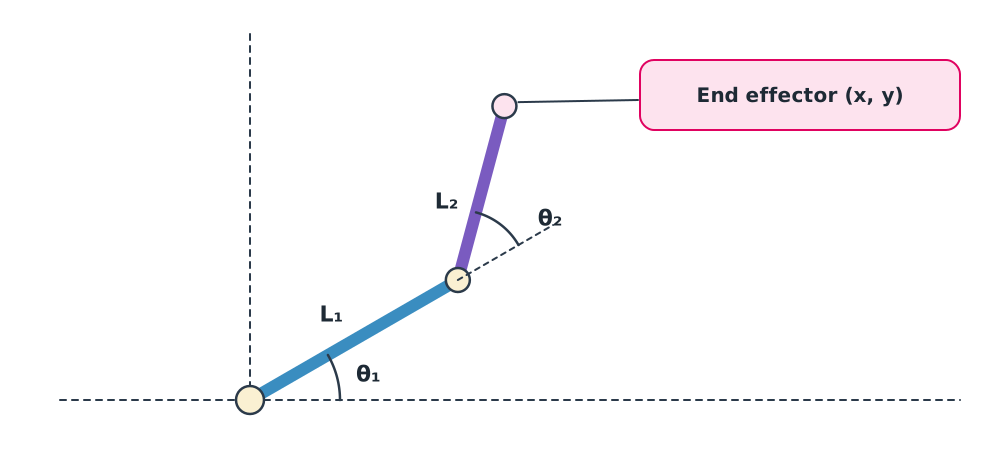
Kinematics of a two-link arm
Forward kinematics
Given the joint angles, find the tip position (Lynch & Park, 2017):
Inverse kinematics
Given a desired position, find the joint angles. This is harder because there may be several solutions or none. From the law of cosines:
If falls outside , the point is outside the workspace. Positive and negative give two solutions (elbow up or elbow down).
Example 1 A battery-swap arm
The arm has m and m.
Forward, at , :
- m
- m
Inverse, to reach m:
- Distance from the base m lies between and m, so it is reachable
- , so
- Checking with forward kinematics gives , as required
Differential-drive robots
Many mobile robots use separately driven left and right wheels (differential drive). With wheel radius , wheels apart, and wheel angular speeds and :
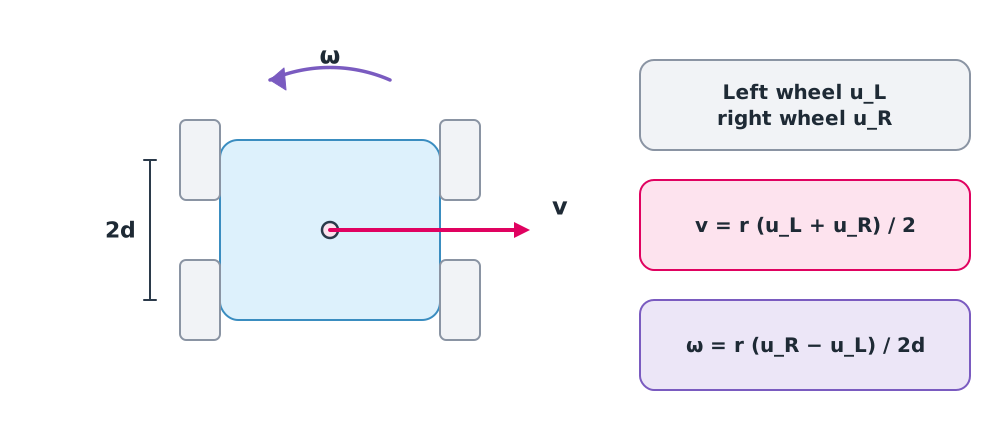
Equal wheel speeds drive straight (); equal and opposite speeds spin on the spot (). This robot cannot move directly sideways, a constraint path planning must respect.
Example 2 A robot collecting boxes from a drone
Wheel radius m, half the track width m, right wheel 10 rad/s, left wheel 8 rad/s.
- m/s
- rad/s (turning left, since the right wheel is faster)
- Turning radius m
Robot safety
ISO 10218-1:2025 sets safety requirements for industrial robots, and ISO/TS 15066:2016 is the technical specification for collaborative robots working near people (now under revision). Principles that also apply when drones and robots work together:
- Separate spaces with fences or presence sensors; slow down or stop when a person enters
- Limit force and power for robots that work close to people
- Accessible emergency stops, and logic where stopping takes priority over running (module 1)
- Assess the risk of the whole work cell, not just the robot (DRT 343 module 3)
Class activity
Activity: An automated battery-swap cell
- Define the drone’s battery-bay position relative to the arm base and calculate the joint angles with inverse kinematics.
- Check that every point is in the workspace and choose the elbow-up or elbow-down solution that avoids the structure.
- Design the path of a differential-drive robot carrying the old battery to the charger, and calculate wheel speeds on the turn.
- List safety measures for when a person walks into the cell.
Common mistakes
Watch out
- Using degrees in functions that expect radians in code
- Not checking the workspace before solving inverse kinematics
- Using atan instead of atan2, giving the wrong quadrant
- Assuming a differential-drive robot can move sideways
- Assessing only the robot’s safety, not the whole cell
Summary
- ISO 8373 defines a robot as a programmed actuated mechanism with a degree of autonomy
- DOF are independent configuration variables; a drone has 6 DOF but 4 direct inputs
- 2R arm FK: ; IK uses the law of cosines and can have two solutions
- Differential drive: ,
- Robot safety uses separation, force limits, emergency stops and whole-cell risk assessment
Check your understanding
- Under the ISO 8373 definition, is a drone flying an automated mission a robot? Why?
- With m, m, and , where is the tip?
- Can the same arm reach a point 0.75 m from its base?
- A differential-drive robot with m has both wheels at 12 rad/s. What is its angular speed?
- If the left wheel turns at −5 rad/s and the right at 5 rad/s, how does the robot move?
Answers
- Yes. It is a programmed, actuated mechanism that moves by itself based on its current state and sensing
- m, m, so
- No. Its maximum reach is m
- ; it drives straight
- ; it spins on the spot, counter-clockwise
Key formulas
| Forward kinematics of a 2R arm | |
| Inverse kinematics (elbow angle) | |
| Differential drive |
Key references
- International Organization for Standardization. (2021). Robotics – Vocabulary (ISO 8373:2021). link
- Lynch, K. M., & Park, F. C. (2017). Modern robotics: Mechanics, planning, and control. Cambridge University Press. link
- Siegwart, R., Nourbakhsh, I. R., & Scaramuzza, D. (2011). Introduction to autonomous mobile robots (2nd ed.). MIT Press.
- International Organization for Standardization. (2025). Robotics – Safety requirements – Part 1: Industrial robots (ISO 10218-1:2025). link
- International Organization for Standardization. (2016). Robots and robotic devices – Collaborative robots (ISO/TS 15066:2016). link
- Corke, P. (2023). Robotics, vision and control (3rd ed.). Springer.
Further reading
Study the assigned knowledge units in advance, review media and take the module quiz
In class / field
Lecture, case discussion and in-class problem solving
Learning evidence: Quiz results and submitted exercises