Atmosphere and basic aerodynamics
DRT 112 Applied Physics for Aircraft Technology
Lesson
By the end of this module you will be able to
- Explain air pressure, temperature and density, and calculate density with the ideal gas law
- Use the International Standard Atmosphere (ISA) to assess the effect of altitude and temperature on flight
- Explain Bernoulli's principle, dynamic pressure and airspeed measurement with a pitot tube
- Use the lift and drag equations to find level-flight speed and stall speed
- Explain angle of attack, stall and the meaning of Reynolds number for small drones
Air is what a drone flies on
A drone does not float in empty space. It flies by pushing and turning the air, so the air’s density, pressure and temperature decide how much force its propellers and wings can make. The same drone may fly well on a cool morning yet lift less on a very hot afternoon in the mountains. This module explains why.
Properties of air
- Pressure (, in Pa) is the force air exerts on one square metre.
- Temperature () must be in kelvin for calculations: .
- Density (, in kg/m³) is the mass of air per unit volume. The denser the air, the more air a propeller has to push.
The three are linked by the ideal gas law:
The International Standard Atmosphere
So that performance can be designed and compared, the International Civil Aviation Organization (ICAO) defines a standard atmosphere (ISA). At sea level:
| Quantity | Sea-level value |
|---|---|
| Temperature | 288.15 K (15 °C) |
| Pressure | 101 325 Pa |
| Density | 1.225 kg/m³ |
In the troposphere, temperature falls by about 6.5 °C per 1000 m:
In this model, at 1000 m the temperature is 281.65 K, the pressure about 89 900 Pa and the density about 1.112 kg/m³, roughly 9% below sea level.
Example 1. A hot day in Thailand
At sea level with 101 325 Pa and 35 °C (308.15 K):
That is about 6.5% below the standard 1.225 kg/m³. Because propeller thrust is proportional to density, thrust at the same speed also falls by about 6.5%. On hot days a drone must spin its propellers faster and use more energy to hover.
Bernoulli’s principle and dynamic pressure
When air flows without losing energy, the sum of static pressure and dynamic pressure is constant along the flow:
The term is the dynamic pressure. It measures how hard the moving air “hits”, and it appears in every lift and drag equation.
Measuring airspeed with a pitot tube
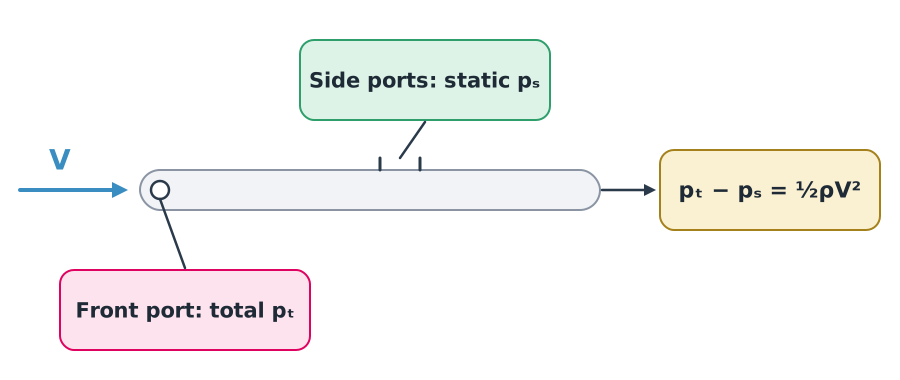
Fixed-wing aircraft measure airspeed with a pitot-static tube. The front port senses total pressure ; the side ports sense static pressure . Their difference is the dynamic pressure.
Example 2. Reading an airspeed sensor
The sensor reads a pressure difference of 150 Pa at kg/m³:
Lift and drag
Wings and propeller blades have an airfoil cross-section. When set at an angle to the oncoming air, the angle of attack (), they turn the air downward. The force perpendicular to the airflow is lift; the force along the airflow is drag.
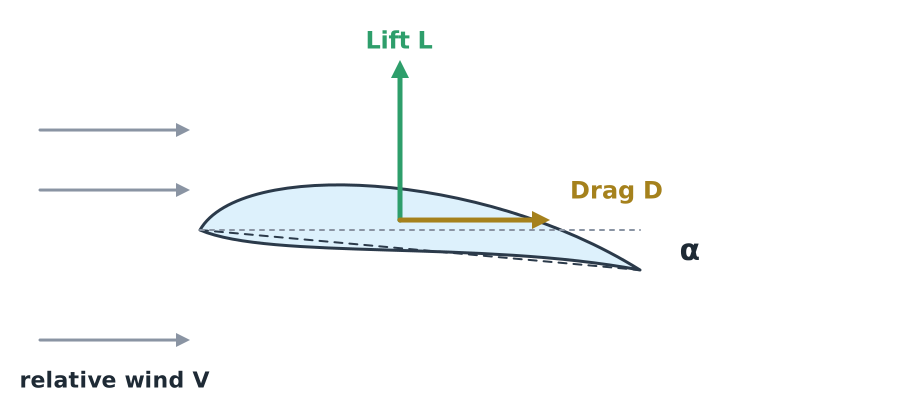
The lift and drag equations have the same form:
where is the wing area and , are the lift and drag coefficients, which gather the effects of shape and angle of attack into a single number. They come from wind-tunnel tests or simulation.
The equation tells us three important things: lift grows with the square of speed, is proportional to air density, and is proportional to wing area.
Example 3. Level-flight speed
A 3 kg fixed-wing drone with a 0.6 m² wing flies at . How fast must it fly to hold level flight?
Level flight means , so
Angle of attack and stall
As angle of attack rises, increases up to a maximum . Beyond that, the air separates from the upper surface and lift drops sharply. This is a stall. The lowest speed at which level flight is still possible is the stall speed:
If the drone in Example 3 has , then m/s. Pilots keep a good margin above this, especially when turning and landing.
Reynolds number
The Reynolds number () compares the air’s inertia with its viscosity:
where is the wing chord. A drone with a 0.2 m chord flying at 12 m/s has , hundreds of times lower than an airliner. At low , viscosity matters more and airfoils are less efficient, so data for large aircraft cannot be applied directly to small drones.
Module lab
In class
- Record temperature and air pressure from a weather station or barometer sensor, then calculate that day’s air density.
- Open NASA’s FoilSim airfoil simulator or a tool chosen by your instructor. Vary angle of attack from 0° to 20°, record and note where stall begins.
- Compare the lift calculated for a hot day with that for a standard day.
Common mistakes
Watch out
- Using Celsius in the gas law. Always convert to kelvin.
- Forgetting to square the speed. Double the speed, four times the lift.
- Assuming more angle of attack is always better. Past the stall angle, lift drops suddenly.
- Using large-aircraft values for small drones. Reynolds numbers differ greatly.
Summary
- Air density falls in hot weather or at altitude, reducing thrust and lift.
- ISA at sea level is 15 °C, 101 325 Pa and 1.225 kg/m³.
- Dynamic pressure is used to measure airspeed with a pitot tube.
- and ; forces grow with the square of speed.
- Past the critical angle of attack a wing stalls, and small drones operate at low Reynolds numbers.
Check your understanding
- What is the air density at 30 °C and 100 000 Pa?
- In the ISA model, what is the temperature at 2000 m in °C?
- An airspeed sensor reads 245 Pa at . What is the airspeed?
- If speed halves, what happens to lift?
- A 0.15 m chord wing flies at 10 m/s at . What is its Reynolds number, roughly?
Answers
- kg/m³
- K, or 2 °C
- m/s
- It falls to one quarter
Key formulas
| Ideal gas law | |
| ISA temperature | |
| Bernoulli | |
| Pitot airspeed | |
| Lift | |
| Drag | |
| Reynolds number |
Key references
- International Civil Aviation Organization. (1993). Manual of the ICAO standard atmosphere: Extended to 80 kilometres (262 500 feet) (Doc 7488, 3rd ed.). link
- NASA Glenn Research Center. (2022). Beginner's guide to aeronautics. link
- Anderson, J. D. (2016). Introduction to flight (8th ed.). McGraw-Hill.
- Serway, R. A., & Jewett, J. W. (2018). Physics for scientists and engineers (10th ed.). Cengage.
Further reading
Study the assigned knowledge units in advance, review media and take the module quiz
Basic aerodynamics: lift, drag and propellers
Reading wind, clouds and near-surface weather
Aerodynamics: from Navier–Stokes to drone models
Reynolds, Mach and choosing the model fidelity
The Navier–Stokes equations: reading mass, force and acceleration
In class / field
Lab or field practice from worksheets with a safety checklist
Learning evidence: Checked worksheets and quiz results