Propellers, thrust and moments
DRT 112 Applied Physics for Aircraft Technology
Lesson
By the end of this module you will be able to
- Explain how a propeller produces thrust using Newton's third law and momentum theory
- Calculate ideal induced power in hover and estimate the real electrical power needed
- Use propeller thrust and power coefficients to analyse the effect of speed and diameter
- Explain how a quadcopter controls roll, pitch and yaw with thrust and reaction torque
- Read BLDC motor data (KV) and propeller sizes
A propeller is a rotating wing
Each propeller blade has an airfoil section like the wing in Module 2. As it spins, it turns air downward; by Newton’s third law the air pushes the propeller up. This force is thrust. Multirotors use propeller thrust to lift, move and control attitude, so the propeller is at the heart of this type of drone.
Momentum theory
The simplest theory treats the whole rotor as a thin actuator disk that accelerates air uniformly downward through it. Air far above is almost still; through the disk it moves at the induced velocity , and far below it speeds up to .
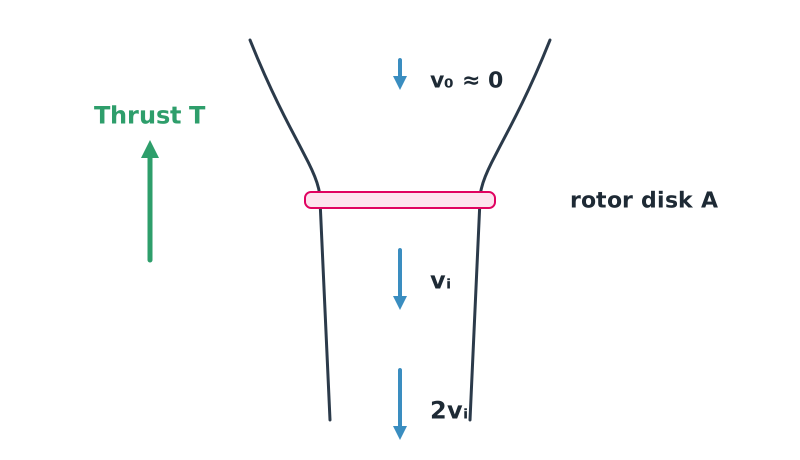
Thrust equals the rate of change of the air’s momentum, . Rearranging gives
where is the disk area and is the ideal induced power, the minimum power needed to produce thrust .
Key idea
is inversely proportional to : larger propellers use less energy for the same thrust, because accelerating a lot of air slowly beats accelerating a little air quickly. Long-endurance drones therefore use large, slow-turning propellers.
Example 1. Power to hover
A 2 kg quadcopter uses four 10-inch (0.254 m) propellers at kg/m³.
- Thrust per rotor N
- Disk area m²
- W per rotor, or 123 W in total
Real propellers are not perfect. The ratio of ideal to actual rotor power is the figure of merit (FM), typically about 0.5–0.7 for small propellers. Including motor and ESC efficiency (see Module 4), the actual electrical power is around 230–250 W.
Propeller coefficients
Real design uses propeller test data expressed as dimensionless coefficients, such as the University of Illinois (UIUC) propeller database:
where is rotational speed in revolutions per second (not rpm) and is diameter in metres.
Example 2. Thrust at 6000 rpm
A 10-inch propeller with spins at 6000 rpm rev/s:
This is close to the hover thrust in Example 1 (4.9 N), so this drone hovers at about 6000 rpm.
The formula shows thrust rises with , as in DRT 111, and with . A propeller just 10% larger gives 46% more thrust at the same speed, but the power required rises with , so the motor needs enough torque.
Propeller size and motor KV
Propellers are labelled diameter × pitch in inches. A 10×4.5 propeller is 10 inches across and would, in theory, advance 4.5 inches per revolution.
BLDC motors are rated in KV, rpm per volt at no load. A 920 KV motor on a 14.8 V battery spins at about rpm without a propeller; with a propeller the speed is lower. Low-KV motors suit large propellers; high-KV motors suit small, fast-spinning ones.
Controlling a quadcopter
A quadcopter has no rudder or tail surfaces. Every movement comes from adjusting the speeds of its four motors.
| Control | How it is done |
|---|---|
| Up/down (throttle) | Change all four speeds equally |
| Roll | Speed up one side, slow the other (left–right) |
| Pitch | Speed up the front, slow the rear, or vice versa |
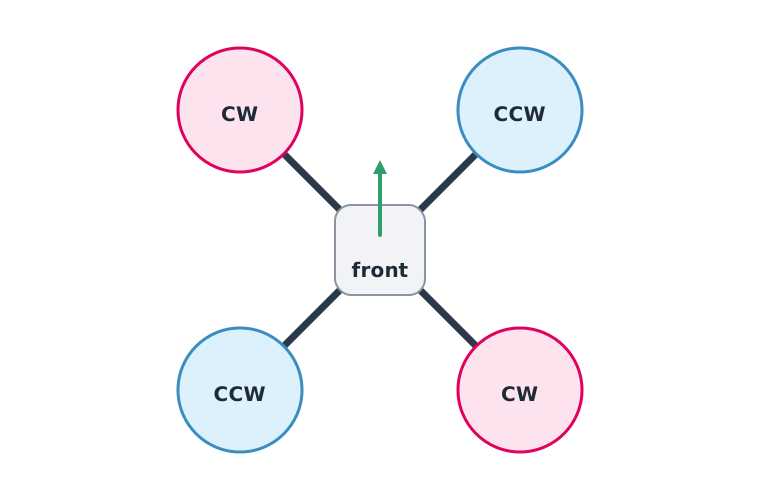
| Yaw | Speed up the clockwise pair and slow the counter-clockwise pair, or vice versa |
Roll and pitch use the moment from thrust difference. With left and right motors at lateral distance from the centre:
Yaw uses reaction torque. A clockwise propeller twists the airframe slightly counter-clockwise. Speeding up the clockwise pair and slowing the counter-clockwise pair keeps total thrust the same but leaves the reaction torques unbalanced, so the drone turns.
Example 3. Roll moment
The left motors give 5.2 N in total and the right 4.6 N, at a lateral distance of 0.18 m.
The left side lifts more, so the drone rolls to the right.
Module lab: measuring a thrust curve
In class (see lab L03 in the knowledge base)
- Mount a motor on a thrust stand with a tachometer, or read rpm from the ESC.
- Record thrust, current and rpm from 20% to 80% throttle in 10% steps.
- Plot thrust against . A near-straight line confirms ; find from the slope.
- Calculate thrust efficiency in grams per watt (gf/W) at each throttle and note how it falls at high throttle.
Safety. Clamp the stand firmly, check rotation direction and propeller nut before powering up, and never stand in the propeller plane.
Common mistakes
Watch out
- Using rpm instead of rev/s in . Divide by 60 first.
- Using diameter in inches. Convert to metres (1 inch = 0.0254 m).
- Fitting propellers the wrong way. Clockwise and counter-clockwise props differ; the wrong one gives reversed thrust and the drone flips on take-off.
- Assuming higher KV is always better. Match KV to propeller size and battery voltage.
Summary
- A propeller makes thrust by pushing air down, by Newton’s third law.
- Momentum theory gives ideal power , so larger propellers save energy.
- Real propellers have a figure of merit below 1, and test data use and .
- Thrust scales with and power with .
- A quadcopter controls roll and pitch by thrust difference and yaw by reaction torque.
Check your understanding
- A 4.5 kg hexacopter hovers. What thrust must each rotor give?
- If disk area doubles at the same thrust, by what factor does ideal induced power change?
- What is 7200 rpm in rev/s?
- A propeller 10% larger spins at the same speed. By what percentage does thrust rise?
- Roughly what no-load speed does a 700 KV motor reach on a 6S (22.2 V) battery?
Answers
- N (about 750 gf)
- , about 29% less
- rev/s
- , about 46% more
- rpm
Key formulas
| Thrust from momentum | |
| Induced velocity | |
| Ideal induced power | |
| Propeller thrust | |
| Propeller power | |
| Roll moment | |
| Approximate no-load speed |
Key references
- Leishman, J. G. (2006). Principles of helicopter aerodynamics (2nd ed.). Cambridge University Press.
- Brandt, J. B., & Selig, M. S. (2011). Propeller performance data at low Reynolds numbers. In 49th AIAA Aerospace Sciences Meeting (AIAA 2011-1255). AIAA. link
- Quan, Q. (2017). Introduction to multicopter design and control. Springer.
- NASA Glenn Research Center. (2022). Beginner's guide to aeronautics. link
Further reading
Study the assigned knowledge units in advance, review media and take the module quiz
Basic aerodynamics: lift, drag and propellers
Comparing propulsion sets
In class / field
Lab or field practice from worksheets with a safety checklist
Learning evidence: Checked worksheets and quiz results