Energy, power and endurance
DRT 112 Applied Physics for Aircraft Technology
Lesson
By the end of this module you will be able to
- Calculate work, kinetic energy, potential energy and power in flight situations
- Explain the efficiency chain from battery to thrust and estimate the electrical power needed
- Assess the effect of payload on power and flight time
- Explain C-rating, internal resistance, voltage sag and heating in batteries
- Apply heat and temperature concepts to safe battery use
Energy limits every mission
In the field, the questions drone users ask most are “how long can it fly?” and “if I add equipment, how much shorter will the flight be?” DRT 111 showed a simple flight-time estimate from battery energy and average power. This module explains where that power comes from, where it is lost, and why weight affects flight time more than you might expect.
Work, energy and power
Work is force times distance moved in the direction of the force, , measured in joules (J). Two kinds of energy are common in drone work:
Power is the rate of using or converting energy, , in watts. When a constant force moves something at constant speed, .
Example 1. Are these energies large or small?
A 2 kg drone flies at 15 m/s at a height of 100 m.
- Kinetic energy J
- Potential energy J, about 0.55 Wh
A 74 Wh battery holds about 135 times this potential energy. Almost all of a multirotor’s energy therefore goes not into height or speed but into pushing air down to stay aloft throughout the flight.
The efficiency chain
Battery energy passes through several stages before it becomes thrust, and each stage loses some as heat.
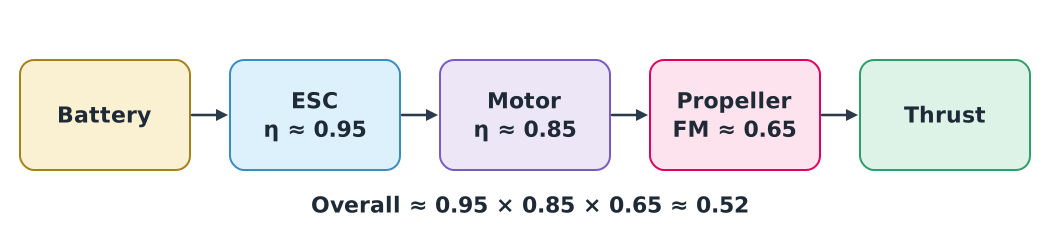
Overall efficiency is the product of the stage efficiencies:
These are approximate values for a typical small drone; real values depend on the equipment and operating point and should be measured, as in the Module 3 lab. The electrical power required is
Example 2. Hover and climb power
From Module 3, a 2 kg drone needs 123 W of ideal induced power.
- Electrical hover power W
- Climbing at 2 m/s needs extra mechanical power W, or W more electrical power
These figures agree with the 300 W average used in DRT 111, which includes manoeuvring and other losses.
Payload and flight time
From Module 3, hover power scales as , and in hover , so
Example 3. Adding 20% mass
Extra equipment raises total mass by 20%.
- Power rises to times
- Flight time on the same battery falls to , about 24% shorter
Mass rises 20% but flight time drops by more. That is why designers fight for every gram, and why a bigger battery does not always add flight time in proportion.
Batteries: current, resistance and heat
C-rating
The C-rating gives the maximum continuous discharge current relative to capacity:
A 5 Ah 25C battery is labelled for A continuous. In practice, label ratings are often optimistic, so leave a margin.
Internal resistance and voltage sag
Every battery has internal resistance . At high current the terminal voltage sags and heat is generated inside:
Example 4. Heat in a battery
A battery with 0.02 Ω total internal resistance supplies 20 A.
- Voltage sag V
- Heat W
- A 10-minute flight generates J. For a 0.5 kg battery with a specific heat of about 1000 J/(kg·K), ignoring cooling, the temperature rises by about K
Internal resistance rises when a battery is very cold or ageing, so voltage sags more under load. The autopilot may then think the battery is nearly empty and return home earlier than necessary.
Lithium battery safety
- Never charge or fly a battery that is swollen, dented or unusually hot.
- Charge in a fire-safe container, supervised, with the charger set to the correct cell count.
- Do not leave batteries in a car in the sun; Thailand’s heat speeds up ageing and raises fire risk.
- For long-term storage, keep cells at about 3.8 V each, as makers recommend.
Module lab
In class
- Using the thrust and power data from the Module 3 lab, find the gf/W efficiency at a thrust of one quarter of the example drone’s weight.
- Estimate the example drone’s hover power and flight time, then compare with a real flight log or the maker’s figure.
- Repeat for payload increases of 10%, 20% and 30%, and plot flight time against mass.
Common mistakes
Watch out
- Assuming hover power is proportional to mass. It scales as .
- Ignoring the efficiency chain. Real electrical power is almost double the ideal power.
- Trusting C-ratings on the label completely. Leave a margin.
- Forgetting heat. High current heats batteries and motors and shortens their life.
Summary
- Work , kinetic energy , potential energy , and power .
- A multirotor spends almost all its energy staying aloft, not storing potential energy.
- Overall efficiency is the product of ESC, motor and propeller efficiencies, often about one half.
- Hover power scales as : 20% more mass cuts flight time by about 24%.
- C-rating limits current; internal resistance causes voltage sag and heating.
Check your understanding
- A 1.5 kg drone climbs 50 m. How much potential energy does it gain?
- With ESC 0.94, motor 0.82 and FM 0.6, what is the overall efficiency?
- Ideal power is 90 W and overall efficiency 0.5. What electrical power is needed?
- If mass falls by 10%, by roughly what percentage does flight time rise?
- What maximum continuous current is a 6 Ah 30C battery labelled for?
Answers
- J
- W
- , about 17% longer
- A
Key formulas
| Work | |
| Kinetic and potential energy | |
| Power | |
| Overall efficiency | |
| Electrical hover power | |
| Effect of mass on hover power | |
| Maximum current from C-rating | |
| Battery heating |
Key references
- Serway, R. A., & Jewett, J. W. (2018). Physics for scientists and engineers (10th ed.). Cengage.
- Leishman, J. G. (2006). Principles of helicopter aerodynamics (2nd ed.). Cambridge University Press.
- Quan, Q. (2017). Introduction to multicopter design and control. Springer.
- Boylestad, R. L., & Nashelsky, L. (2013). Electronic devices and circuit theory (11th ed.). Pearson.
Further reading
Study the assigned knowledge units in advance, review media and take the module quiz
Energy, power and heat in aircraft systems
Payload mass, centre of gravity and energy
In class / field
Lab or field practice from worksheets with a safety checklist
Learning evidence: Checked worksheets and quiz results