Mechanics and the four forces
DRT 112 Applied Physics for Aircraft Technology
Lesson
By the end of this module you will be able to
- Explain Newton's three laws of motion with examples from drone flight
- Draw free-body diagrams of a multirotor and a fixed-wing aircraft
- Calculate net force, acceleration and thrust-to-weight ratio
- Resolve tilted thrust into components and find horizontal acceleration
- Use force and moment balance to analyse an off-centre payload
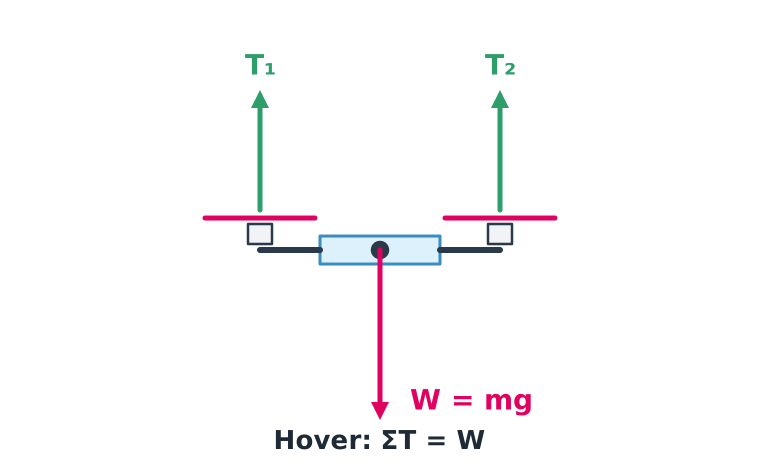
Why a drone can hover
A hovering drone looks as if nothing is happening, but several forces act at once and cancel exactly. Change any one slightly and the drone accelerates, drops or tilts at once. Understanding forces is therefore the basis of everything in this programme, from choosing motors and mounting payloads to tuning the control system.
This module uses the vectors from DRT 111 to describe the forces on an aircraft, starting with Newton’s laws.
Newton’s laws of motion
First law (inertia). An object stays at rest or moves at constant velocity if the net force on it is zero. A hovering drone and a drone flying straight at constant speed both have zero net force.
Second law (force and acceleration). Net force equals mass times acceleration:
Third law (action and reaction). When one object pushes another, the second pushes back with an equal and opposite force. A propeller pushes air down, so the air pushes the propeller up. That is where thrust comes from.
Mass and weight
Mass (, in kg) is the amount of matter and does not change with location. Weight (, in N) is the force of gravity on that mass:
We often say “the drone weighs 2 kilograms”, meaning its mass. Its actual weight is N. Motor makers usually quote thrust in “grams” (gram-force); convert to newtons by multiplying by . For example, 1000 gf is about 9.81 N.
Free-body diagrams
A free-body diagram isolates an object and shows only the external forces acting on it, with their directions. It is the first step in every mechanics problem.
A fixed-wing aircraft has four main forces: lift from the wing, weight, thrust from the propeller or engine, and drag from the air.
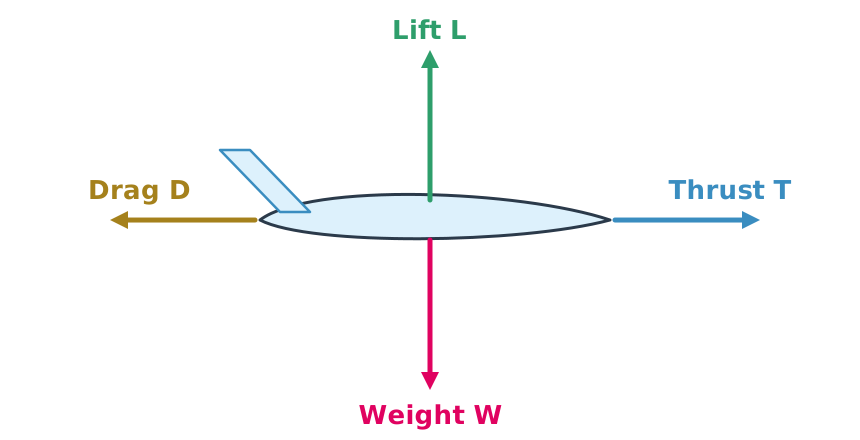
In level flight at constant speed the net force is zero, so and . A multirotor is different: its rotors provide both lift and thrust at the same time.
Net force and acceleration
Example 1. Climbing
A 2 kg drone’s rotors produce 25 N of total upward thrust. What is its acceleration?
- Weight N
- Net upward force N
- Acceleration m/s² upward
Thrust-to-weight ratio
The thrust-to-weight ratio (TWR) is maximum thrust divided by weight. At TWR = 1 the drone can just hover, with nothing left for climbing, fighting wind or correcting attitude. In practice, general-purpose multirotors are designed for a TWR of about 2 or more, hovering at around half throttle; racing drones can reach 5–10.
Example 2. Sizing motors
A 1.5 kg quadcopter needs TWR = 2. What maximum thrust must each motor give?
- Total thrust needed N
- Per motor N, about 750 gf
Tilting to move
A multirotor has no forward-facing propeller. It moves horizontally by tilting, which tilts its thrust. The thrust then has two components.
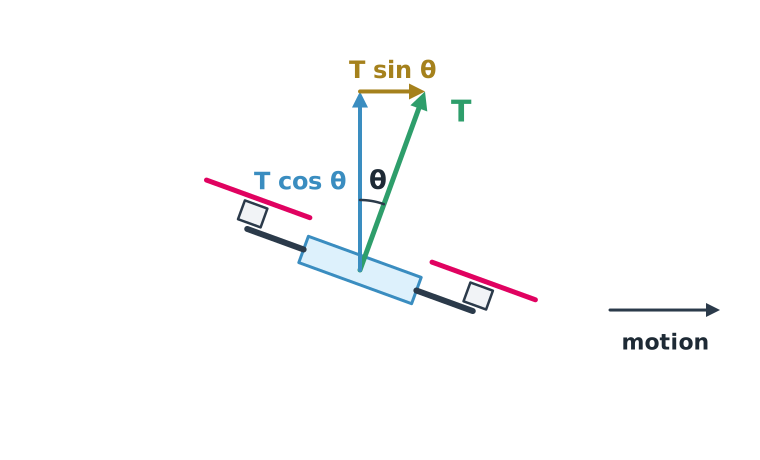
- The vertical component supports the weight.
- The horizontal component accelerates the drone forward.
To hold height, the vertical forces must balance, , so
Example 3. Tilting 20 degrees
- Thrust needed , 6.4% more than in hover
- Horizontal acceleration m/s²
This is why a drone uses more energy flying fast or into wind: it must tilt further and raise total thrust.
Moments and equilibrium
A force acting away from a pivot can make an object rotate. This turning effect is a moment (torque), equal to force times perpendicular distance from the pivot:
An object is in equilibrium when both net force and net moment are zero, and . For a drone, the key pivot is the centre of gravity (CG).
Example 4. Camera mounted forward
A 0.3 kg camera is mounted 0.10 m ahead of the original CG. The front and rear motors are 0.20 m from the centre.
- Nose-down moment from the camera N·m
- To balance it, the front motors must give N more total thrust than the rear
The front motors work harder, run hotter and drain the battery faster. Keeping the CG at the centre of the frame matters a great deal; DRT 332 returns to this in detail.
Momentum and impulse
Momentum is mass times velocity, . When velocity changes in a short time, large forces arise, as described by impulse:
Example 5. A hard landing
A 2 kg drone hits the ground at 3 m/s and stops in 0.05 s. The average force is N, about six times its weight. Flexible landing gear lengthens and so reduces the force.
Module lab: measuring thrust with a scale
In class
- Mount a motor and propeller upside down on a test stand placed on a digital scale, so the propeller blows air upward.
- Set throttle to 25%, 50% and 75%; record the scale reading (gf) and current (A).
- Convert to newtons and work out what mass of drone would have TWR = 2 with four of these motors.
Safety. Remove propellers whenever the battery is connected for setup. Always stand to the side of the propeller plane, wear eye protection and keep a fire-safe container for batteries.
Common mistakes
Watch out
- Confusing mass and weight. Multiply by before comparing with thrust in newtons.
- Forgetting gf units. Makers quote thrust in grams; convert before calculating.
- Thinking hover means no forces. Forces are present but cancel exactly.
- Assuming thrust stays the same when tilting. Thrust must rise to hold height.
Summary
- Newton’s three laws explain why a drone hovers, accelerates and produces thrust.
- Weight is in newtons; makers quote thrust in gf.
- Free-body diagrams come first; a fixed-wing aircraft has four main forces.
- A TWR of about 2 or more gives control margin.
- Tilting to move requires thrust and gives acceleration .
- Moment ; equilibrium needs and , and an off-centre CG makes some motors work harder.
Check your understanding
- What is the weight of a 3 kg drone in newtons?
- A 1.2 kg drone has 15 N of total thrust. What is its vertical acceleration?
- A 2.5 kg drone needs TWR = 2 with six motors. What thrust in gf must each give?
- Tilting at while holding height, by what percentage must thrust rise, and what is the horizontal acceleration?
- A 0.5 kg battery is mounted 0.04 m behind the CG. What moment does it create?
Answers
- N
- m/s² upward
- kgf total, divided by 6 gives about 833 gf each
- , about 15.5% more, and m/s²
- N·m (nose up)
Key formulas
| Newton's second law | |
| Weight | |
| Thrust-to-weight ratio | |
| Thrust when tilted at constant height | |
| Moment | |
| Equilibrium | |
| Impulse |
Key references
- Serway, R. A., & Jewett, J. W. (2018). Physics for scientists and engineers (10th ed.). Cengage.
- NASA Glenn Research Center. (2022). Beginner's guide to aeronautics. link
- Quan, Q. (2017). Introduction to multicopter design and control. Springer.
- Anderson, J. D. (2016). Introduction to flight (8th ed.). McGraw-Hill.
Further reading
Study the assigned knowledge units in advance, review media and take the module quiz
Mechanics, forces, moments and rotational dynamics
UAV/UAS fundamentals and flight simulation
In class / field
Lab or field practice from worksheets with a safety checklist
Learning evidence: Checked worksheets and quiz results