Permissions
DRT 343 Regulations, Safety, Risk Management and Ethics for Unmanned Aircraft Systems
Lesson
By the end of this module you will be able to
- Summarise the general flight conditions of the 2015 Ministry of Transport notification
- Explain pilot registration and its validity
- Explain the Specific Category path from training to per-flight permission
- Calculate expiry and renewal deadlines for registrations and privileges
- Check airspace in the eAIP and no-fly notifications, and calculate distance from coordinates
Why this matters
A skilled pilot who files incomplete documents, or does not know the site is in a restricted area, either cannot fly or flies illegally. Paperwork and airspace checks are part of professionalism, not clerical work to do afterwards.
It is like travelling abroad: you need an unexpired passport (pilot registration), a visa for the right purpose (privilege and permission), and to know which areas are off-limits (airspace).
General conditions under the 2015 notification
Clause 5 sets the conditions for hobby drones up to 2 kg. Clause 9 applies the same conditions to registered pilots, with some extra duties, and clause 13 applies clause 9 to other purposes mutatis mutandis. The main in-flight conditions are:
| Condition | Content |
|---|---|
| Visual contact | The pilot must see the aircraft at all times; flying only through an onboard camera is prohibited |
| Time | Only between sunrise and sunset; do not fly near or into cloud |
| Height | Not above 90 m (300 ft) above ground |
| Aerodromes | No flying within 9 km (5 NM) of an aerodrome or temporary landing site unless the aerodrome operator permits |
| Areas | No entry into prohibited, restricted or danger areas published in the AIP, and no flying over government premises or hospitals, without permission |
| Communities | No flying over cities, villages, communities or gatherings of people |
| Separation | At least 30 m horizontally from people, vehicles, structures and buildings under clause 5, and 50 m for registered pilots under clause 9 |
| Other | Do not approach crewed aircraft, violate privacy or cause nuisance; no dangerous goods or laser devices |
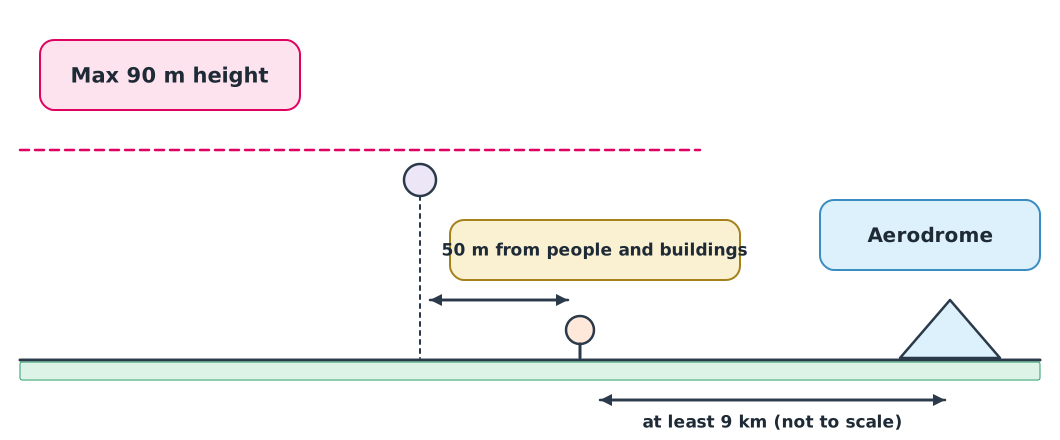
Before flight, check the aircraft is airworthy, obtain the landowner’s permission, study the area and airspace, and have an emergency plan. Registered pilots have extra duties: maintain the aircraft per the manufacturer’s manual, know air-traffic rules, carry the registration document and a fire extinguisher, hold third-party liability insurance of at least 1 million baht per occurrence, and report any accident to the competent official without delay.
Pilot registration
Pilots register through CAAT’s UAS Portal, which includes an online knowledge exam (E-Exam). According to CAAT’s service guide, a candidate who fails may retake it after 24 hours. Registration under the 2015 notification is valid for 2 years, and renewal must be filed at least 30 days before expiry.
The Specific Category path
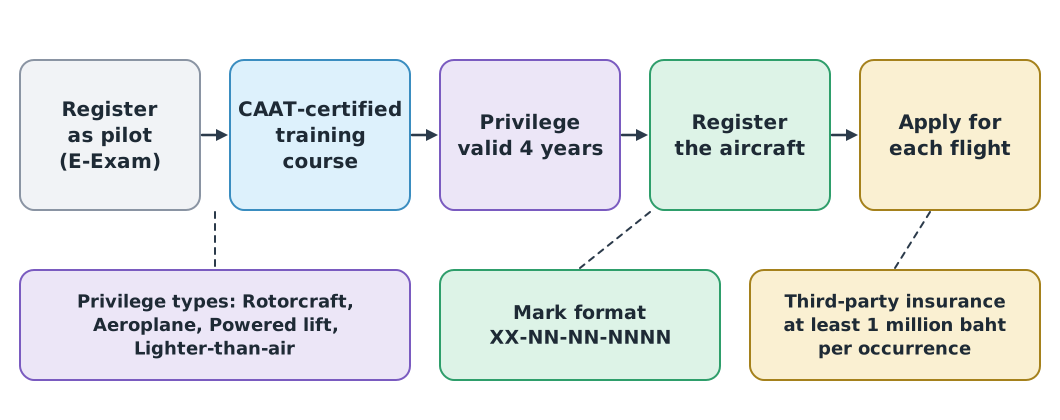
Operations that depart from the general conditions, such as night flight, flight above 90 m or closer to people than allowed, follow the 2026 CAAT notification. It has three main parts: the pilot’s privilege, aircraft registration and per-flight permission.
| Part | Content of the notification |
|---|---|
| Pilot requirements (clause 5) | Registered under the 2015 notification, passed a Specific Category course from a CAAT-certified training centre, and holding a privilege |
| Privileges (clauses 6–12) | Four types: Rotorcraft (including multirotor and helicopter), Aeroplane, Powered lift and Lighter-than-air. A first application needs training completed within the past year. Valid 4 years from the recording date. Renewal must be filed at least 30 days before expiry with a skills assessment from a certified centre within 6 months. Holders must not use psychoactive substances |
| Aircraft registration (clauses 13–19) | Required before any Specific flight. Mark format XX-NN-NN-NNNN, on the main body, visible to the naked eye, characters taller than 0.3 cm in a contrasting colour. Registration ends on transfer, damage beyond use, loss for over 60 days, use in an offence, or death of the registrant |
| Per-flight permission (clauses 20–22) | Apply before every flight, stating purpose, date and time, area and coordinates, registration mark, procedures and flight profile, pilot names, and third-party insurance of at least 1 million baht per occurrence. CAAT may request an operations manual, a risk-management manual, extra measures or a demonstration flight, and may permit per flight or for a period |
Transitional provisions: permissions granted under the old clause 17 remain valid until they expire. For already-registered pilots, amendment No. 2 (June 2026) extended the transitional provisions to pilots registered up to 1 March 2027. Read the notification for the detailed conditions.
Example 1 Planning a renewal calendar
A privilege was recorded on 1 July 2026.
- Valid 4 years from recording: it expires on 30 June 2030
- Renewal must be filed at least 30 days before expiry: by 31 May 2030
- The skills assessment must be within 6 months before filing; if filing on 31 May 2030, the assessment must be no earlier than 30 November 2029
A pilot registration issued on 1 October 2026 is valid 2 years, expiring 30 September 2028, with renewal due by 31 August 2028. Put all these dates in the organisation’s calendar, because registrations and privileges do not expire together.
Checking airspace
The eAIP and restricted areas
Thailand’s Aeronautical Information Publication (AIP) is published electronically (eAIP) at aip.caat.or.th and updated on the AIRAC cycle. Section ENR 5.1 lists prohibited (VTP), restricted (VTR) and danger (VTD) areas. Open the edition in force on the day of flight; on the date checked it was AIRAC AMDT 09/26 (effective 3 September 2026).
A key example is VTR1 BANGKOK CITY: a circle of 10 NM radius around 13°45′54″N 100°32′18″E, from ground to 3,000 ft, active 24 hours. Only aircraft authorised by CAAT or under air traffic control may enter.
No-fly areas from specific notifications
Beyond the AIP, CAAT issues topic-specific notifications. Notification No. 16 (June 2026) bans flights in listed districts of 7 provinces along the Thai–Cambodian border: Ubon Ratchathani, Si Sa Ket, Surin, Buri Ram, Sa Kaeo, Chanthaburi and Trat. It has exceptions such as agriculture and disaster relief, and requires every flight to be approved through the UAS Portal first. Notifications like this change with circumstances; check the latest before every flight.
Distance from coordinates
The great-circle distance between two points is given by the haversine formula, with latitude , longitude and km:
Example 2 Is the site inside VTR1?
The flight site is at 13°50′00″N 100°40′00″E.
- VTR1 radius km
- Convert the centre to decimal degrees: 13.7650°N 100.5383°E; the site is 13.8333°N 100.6667°E
- The haversine formula gives km
- , so the site is inside VTR1 and needs CAAT authorisation first
Example 3 Distance from an aerodrome (hypothetical data)
A hypothetical aerodrome is at 14.0000°N 100.5000°E and the site at 14.0500°N 100.5400°E.
The distance is km, less than 9 km, so the aerodrome operator’s permission is required under the general conditions. A 2018 CAAT notification sets out who decides within this distance, such as the aerodrome operator, or under a civil–military agreement for shared aerodromes.
Radio frequencies
Radio equipment on the drone and controller is regulated by NBTC, which is separate from CAAT registration. Check the current NBTC notifications on frequency bands and registration. In 2026 NBTC held public hearings on several new draft notifications, which were still drafts on the date checked.
Class activity
Activity: Preparing a per-flight application pack
Use the knowledge units “Checking conditions before applying to operate” and “Preparing data before registration” from the drone knowledge hub.
- The instructor sets a hypothetical mission requiring night flight over a construction site.
- Check the current eAIP for VTP, VTR or VTD areas and calculate the distance to the nearest aerodrome.
- Draft every item required by clause 21, noting whether the evidence exists or is missing.
- Build an expiry calendar for the team’s registrations and privileges.
Do not enter real data into CAAT systems during the exercise.
Common mistakes
Watch out
- Confusing the privilege with pilot registration; they have different validity (4 years versus 2 years)
- Filing a renewal on the last day when it must be at least 30 days ahead
- Relying on a green map app instead of the eAIP; app colours are not permission
- Forgetting temporary no-fly notices, such as the border areas
- Putting the registration mark on the battery or a removable part instead of the main body
Summary
- General conditions: keep visual contact, fly in daylight, stay below 90 m, 9 km from aerodromes, not over communities, 30 m from people and buildings (50 m for registered pilots)
- Pilot registration under the 2015 notification is valid 2 years and includes an E-Exam
- Specific Category needs a privilege (valid 4 years), aircraft registration and per-flight permission with insurance of at least 1 million baht per occurrence
- Always check the eAIP in force and any specific no-fly notices
- Distances from coordinates use the haversine formula, and 1 NM = 1.852 km
Check your understanding
- What is the minimum horizontal distance from people for a pilot registered under clause 9?
- A privilege is recorded on 15 January 2027. When does it expire, and by when must renewal be filed?
- List four items that a Specific Category per-flight application must state.
- What is the radius of VTR1 in kilometres?
- The site is 8.2 km from an aerodrome. What must be done under the general conditions?
Answers
- 50 m
- It expires on 14 January 2031; renewal must be filed by 15 December 2030
- For example: purpose, date, time, area and coordinates, aircraft registration mark, procedures and flight profile, pilot names, and third-party insurance of at least 1 million baht per occurrence
- km
- It is within 9 km, so the aerodrome operator’s permission is needed first
Key formulas
| Great-circle distance (haversine) | |
| Nautical mile |
Key references
- กระทรวงคมนาคม. (2558). ประกาศกระทรวงคมนาคม เรื่อง หลักเกณฑ์การขออนุญาตและเงื่อนไขในการบังคับหรือปล่อยอากาศยานซึ่งไม่มีนักบิน ประเภทอากาศยานที่ควบคุมการบินจากภายนอก พ.ศ. 2558. ราชกิจจานุเบกษา, 132(86 ง), 6–12. link
- สำนักงานการบินพลเรือนแห่งประเทศไทย. (2569). ประกาศ กพท. เรื่อง หลักเกณฑ์และวิธีการในการอนุญาตให้ผู้บังคับหรือปล่อยอากาศยานซึ่งไม่มีนักบิน ประเภทอากาศยานที่ควบคุมการบินจากภายนอก ที่มีน้ำหนักไม่เกิน 25 กิโลกรัม ปฏิบัติแตกต่างไปจากเงื่อนไขที่กำหนด พ.ศ. 2569 (มีผล 17 พฤษภาคม 2569). link
- สำนักงานการบินพลเรือนแห่งประเทศไทย. (2569). ประกาศ กพท. เรื่อง หลักเกณฑ์และวิธีการในการอนุญาตให้ผู้บังคับหรือปล่อยอากาศยานซึ่งไม่มีนักบิน ประเภทอากาศยานที่ควบคุมการบินจากภายนอก ที่มีน้ำหนักไม่เกิน 25 กิโลกรัม ปฏิบัติแตกต่างไปจากเงื่อนไขที่กำหนด (ฉบับที่ 2) พ.ศ. 2569. link
- สำนักงานการบินพลเรือนแห่งประเทศไทย. (2569). ประกาศ กพท. เรื่อง หลักเกณฑ์และวิธีการรับรองศูนย์ฝึกอบรมและหลักสูตรฝึกอบรมผู้บังคับหรือปล่อยอากาศยานซึ่งไม่มีนักบิน ประเภทอากาศยานที่ควบคุมการบินจากภายนอก พ.ศ. 2569. link
- สำนักงานการบินพลเรือนแห่งประเทศไทย. (2568). แนวทางการขอรับบริการสำหรับผู้รับบริการ UAS. link
- สำนักงานการบินพลเรือนแห่งประเทศไทย. (2026). Aeronautical information publication Thailand (eAIP), ENR 5.1 Prohibited, restricted and danger areas (AIRAC AMDT 09/26). link
- สำนักงานการบินพลเรือนแห่งประเทศไทย. (2561). ประกาศ กพท. เรื่อง แนวทางในการพิจารณาอนุญาตให้บังคับหรือปล่อยอากาศยานซึ่งไม่มีนักบินภายในระยะเก้ากิโลเมตรจากสนามบิน พ.ศ. 2561. link
- สำนักงานการบินพลเรือนแห่งประเทศไทย. (2569). ประกาศ กพท. เรื่อง ห้ามบังคับหรือปล่อยอากาศยานซึ่งไม่มีนักบินในพื้นที่ที่อาจกระทบต่อความมั่นคง (สถานการณ์ชายแดนไทย–กัมพูชา) (ฉบับที่ 16) พ.ศ. 2569. link
- สำนักงานการบินพลเรือนแห่งประเทศไทย. (2565). รูปแบบคู่มือปฏิบัติการบินของอากาศยานซึ่งไม่มีนักบิน (CAAT-GM-UAS-001, Issue 01 Rev 00). link
Further reading
Study the assigned knowledge units in advance, review media and take the module quiz
Checking conditions before applying to operate
Preparing information before registration
In class / field
Lecture, case discussion and in-class problem solving
Learning evidence: Quiz results and submitted exercises