Aviation law
DRT 343 Regulations, Safety, Risk Management and Ethics for Unmanned Aircraft Systems
Lesson
By the end of this module you will be able to
- Explain the hierarchy of Thai drone law from the Act down to per-flight permission
- Identify the agencies involved in a drone mission and what to check with each
- Classify drone use under the 2015 Ministry of Transport notification and identify when Specific Category permission is needed
- Compare the Thai framework with ICAO and European Union concepts
- Read legislation by separating signing, publication and effective dates, and check the latest amendments
Why this matters
Before every flight a professional drone operator must be able to answer “under which rule is this mission legal?” “The aircraft is registered” is not enough, because registration is only one condition. There are also rules about the pilot, the area, height, time, radio frequencies and personal data. Flying outside the conditions is a criminal offence and may void insurance cover.
Drone law is like traffic law. The Act is the broad principle that you need a licence and must follow the rules. Notifications are the road signs and detailed rules. Per-flight permission is like applying to close a road for a single event. A good driver knows every layer.
The information in this lesson was checked against the notification texts on 26 September 2026. Drone law changes often, so always check the latest versions on CAAT’s UAS Portal before use.
The hierarchy of law
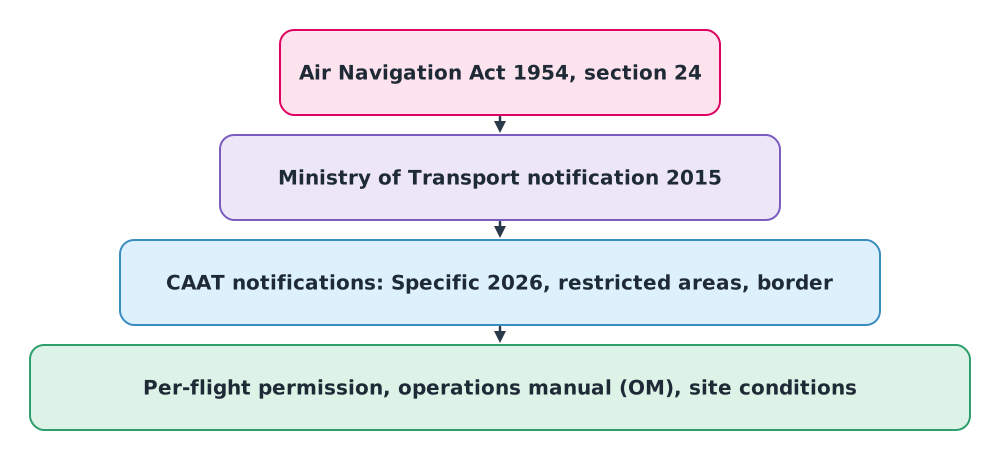
| Layer | Key content |
|---|---|
| Air Navigation Act 1954 | Section 24 prohibits operating or releasing a pilotless aircraft without the Minister’s written permission and compliance with the Minister’s conditions. Violations are punishable under section 78(1) by up to 1 year in prison, a fine of up to 40,000 baht, or both |
| Ministry of Transport (MOT) notification 2015 | Signed 2 July 2015, published in the Royal Gazette on 27 August 2015. It grants permission and sets general conditions under section 24 for drones up to 25 kg: categories of use, registration and flight conditions |
| CAAT notifications | Detailed rules on specific topics, such as Specific Category operations (2026 and amendment No. 2), prohibited, restricted and danger areas (2025 and amendment No. 2 of 2026), the ban along the Thai–Cambodian border (No. 16 of 2026), and guidelines for permission within 9 km of an aerodrome (2018) |
| Per-flight permission and OM | Conditions tied to one mission, such as area, time and extra measures, plus the procedures in the operator’s operations manual |
Drones heavier than 25 kg have a separate regime, starting with an MOT notification in 2024 (in force 1 September 2024) and amendments in 2025 and 2026. This lesson focuses on drones up to 25 kg, which cover most work.
Key idea: read all three dates
A notification has a signing date, a Royal Gazette publication date and an effective date, and they may differ. The CAAT Specific Category notification was signed on 17 April 2026; CAAT states it took effect on 17 May 2026, but the Royal Gazette issue is dated 8 June 2026, and amendment No. 2 (June 2026) later changed its transitional provisions. Anyone who read only the first news reports has incomplete information.
Who is involved in one mission
One drone mission touches many rules, so registration with one agency does not mean every aspect is authorised (review the knowledge unit “Where drone law starts”).
| Topic | Agency or party | What to check |
|---|---|---|
| Pilot, aircraft and flight conditions | CAAT, via the UAS Portal | Registration, privileges, permissions |
| Area and airspace | CAAT (eAIP, restricted-area notifications), aerodrome operators | Prohibited, restricted or danger areas; distance from aerodromes |
| Radio frequencies and equipment | NBTC | Radio equipment registration, permitted bands |
| Use of the site | Landowner or site manager | Consent, contact person |
| Personal data in imagery | Data controller under the PDPA (module 5) | Lawful basis, retention |
| Security and unlawful activity | Police, security agencies | Temporary no-fly notices |
Categories of use under the 2015 notification
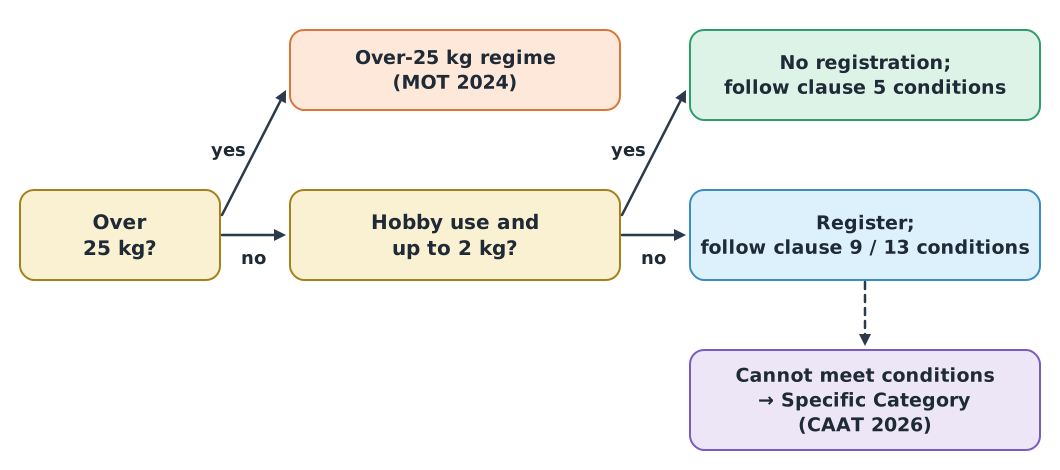
Clause 4 of the 2015 MOT notification classifies drones up to 25 kg by purpose.
| Category | Example | Registration | Conditions |
|---|---|---|---|
| (1)(a) Hobby, entertainment or sport, up to 2 kg | A club racing drone | Not required | Clause 5 |
| (1)(b) Hobby, over 2 kg up to 25 kg | A large model aircraft | Required | Clause 9 |
| (2) Other purposes, up to 25 kg | News reporting, photography or filming, aircraft R&D, others | Required at any weight | Clause 13 (applies clause 9 mutatis mutandis) |
When an operator cannot meet the conditions of clause 5, 9 or 13, for example because it must fly higher than allowed or at night, clause 17 of the same notification allows permission to operate differently. This now follows the 2026 CAAT notification on “medium-risk operations (Specific Category)”, which require a risk assessment and authorisation before flight (module 2).
Example 1 Classifying four cases
- A racing club flies a 0.8 kg drone on its own field for sport → category (1)(a); no registration, but every clause 5 condition applies
- A mapping company uses a 6 kg drone to survey farmland for a client → other purpose; registration required; clause 13 conditions apply
- The same company needs to fly at 150 m for wider coverage → beyond the general conditions (max 90 m); Specific Category permission required
- A 40 kg take-off-weight spraying drone → over 25 kg; the over-25 kg regime applies
In every case also check no-fly notices. If the job is in a district covered by CAAT notification No. 16 on the border, registration alone is not enough.
Comparison with international frameworks
- ICAO sets broad principles through the Annexes to the Chicago Convention and the RPAS manual (Doc 10019), focused on aircraft sharing airspace with crewed aviation. Each state writes its own rules for small drones
- The European Union, in Regulation (EU) 2019/947, divides operations into three risk-based categories: open, specific and certified
- Thailand uses the general conditions of the 2015 notification as its base and the term Specific Category in the 2026 CAAT notification for operations that depart from those conditions
Do not assume foreign frameworks apply in Thailand. Weight thresholds, purposes and conditions differ. Always cite the rule in force in the country where you fly.
Class activity
Activity: Four-way requirements table
Use core lesson G01 “Checking roles and evidence before planning a mission” from the drone knowledge hub.
- The instructor sets three hypothetical missions, such as filming a graduation ceremony, inspecting a factory roof 12 km from an airport, and surveying land in a border province.
- Classify each with Figure 2.
- Build a table covering pilot, aircraft, area and radio, stating the agency, the notification version, the date checked and the status (confirmed / to check).
- Present which questions remain open and whom to ask.
Common mistakes
Watch out
- Assuming registration means you can fly anywhere at any time
- Reading only the news, not the notification itself or its amendments
- Confusing signing, publication and effective dates
- Applying foreign rules, or citing a draft as if it were in force
- Forgetting non-flight matters such as radio, site use and personal data
Summary
- Thai drone law is layered: Air Navigation Act section 24 → 2015 MOT notification → CAAT notifications → per-flight permission and OM
- Flying without section 24 permission is punishable under section 78(1) by up to 1 year in prison, a fine of up to 40,000 baht, or both
- The 2015 notification separates hobby use up to 2 kg (no registration), hobby use over 2 kg, and other purposes (registration required)
- Operations outside the general conditions need Specific Category permission under the 2026 CAAT notification
- One mission involves several agencies; always read the effective date and the latest amendments
Check your understanding
- Which section of the Air Navigation Act is the basis for permitting drone flight?
- A 1.2 kg drone is used to film weddings for hire. Must it be registered? Why?
- A registered pilot needs to fly at night. What must they do?
- Why must a notification’s effective date be read separately from its signing date?
- Apart from CAAT, which agencies or parties can a drone mission involve? Give two examples.
Answers
- Section 24
- Yes. It is used for another purpose (photography), not hobby use, and the 2015 notification requires registration at any weight in that case
- Night flight is outside the general conditions (flights only between sunrise and sunset), so they must apply for Specific Category permission under the 2026 CAAT notification
- The three dates may differ, and rights and duties start on the effective date; later amendments must also be checked
- For example NBTC (frequencies and radio equipment), the landowner (consent to use the site), the aerodrome operator, or the police
Key references
- พระราชบัญญัติการเดินอากาศ พ.ศ. 2497 และที่แก้ไขเพิ่มเติม (คำแปลภาษาอังกฤษของ กพท. แก้ไขถึงฉบับที่ 14 พ.ศ. 2562). link
- กระทรวงคมนาคม. (2558). ประกาศกระทรวงคมนาคม เรื่อง หลักเกณฑ์การขออนุญาตและเงื่อนไขในการบังคับหรือปล่อยอากาศยานซึ่งไม่มีนักบิน ประเภทอากาศยานที่ควบคุมการบินจากภายนอก พ.ศ. 2558. ราชกิจจานุเบกษา, 132(86 ง), 6–12. link
- สำนักงานการบินพลเรือนแห่งประเทศไทย. (2569). ประกาศ กพท. เรื่อง หลักเกณฑ์และวิธีการในการอนุญาตให้ผู้บังคับหรือปล่อยอากาศยานซึ่งไม่มีนักบิน ประเภทอากาศยานที่ควบคุมการบินจากภายนอก ที่มีน้ำหนักไม่เกิน 25 กิโลกรัม ปฏิบัติแตกต่างไปจากเงื่อนไขที่กำหนด พ.ศ. 2569 (มีผล 17 พฤษภาคม 2569). link
- สำนักงานการบินพลเรือนแห่งประเทศไทย. (2569). ประกาศ กพท. เรื่อง หลักเกณฑ์และวิธีการในการอนุญาตให้ผู้บังคับหรือปล่อยอากาศยานซึ่งไม่มีนักบิน ประเภทอากาศยานที่ควบคุมการบินจากภายนอก ที่มีน้ำหนักไม่เกิน 25 กิโลกรัม ปฏิบัติแตกต่างไปจากเงื่อนไขที่กำหนด (ฉบับที่ 2) พ.ศ. 2569. link
- สำนักงานการบินพลเรือนแห่งประเทศไทย. (2569). ประกาศ กพท. เรื่อง กำหนดพื้นที่หวงห้ามเด็ดขาด พื้นที่หวงห้ามเฉพาะ และพื้นที่อันตราย (ฉบับที่ 2) พ.ศ. 2569. link
- สำนักงานการบินพลเรือนแห่งประเทศไทย. (2569). ประกาศ กพท. เรื่อง ห้ามบังคับหรือปล่อยอากาศยานซึ่งไม่มีนักบินในพื้นที่ที่อาจกระทบต่อความมั่นคง (สถานการณ์ชายแดนไทย–กัมพูชา) (ฉบับที่ 16) พ.ศ. 2569. link
- International Civil Aviation Organization. (2015). Manual on remotely piloted aircraft systems (RPAS) (Doc 10019). ICAO. link
- European Commission. (2019). Commission Implementing Regulation (EU) 2019/947 on the rules and procedures for the operation of unmanned aircraft. link
Further reading
Study the assigned knowledge units in advance, review media and take the module quiz
Law and registration
Who regulates drones
Checking roles and evidence before mission planning
In class / field
Lecture, case discussion and in-class problem solving
Learning evidence: Quiz results and submitted exercises