Series, parallel circuits and Kirchhoff's laws
DRT 113 Fundamentals of Electrical and Electronics
Lesson
By the end of this module you will be able to
- Calculate total resistance of series, parallel and combined circuits
- Use Kirchhoff's current and voltage laws to analyse circuits
- Design a voltage divider for battery sensing with an ADC
- Explain S and P battery cell arrangements and calculate voltage, capacity and energy
- Explain power distribution through a drone's distribution board
From one resistor to real circuits
Drone circuits never have just one component. The battery feeds several motors at once, cells combine into packs, and the flight controller measures battery voltage through two resistors. This module shows how to analyse multi-component circuits with Kirchhoff’s two basic laws.
Series and parallel circuits
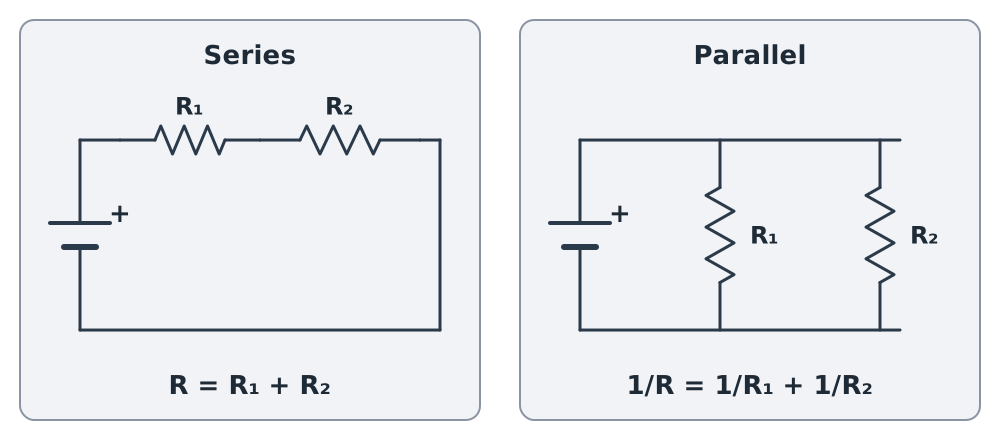
In series, components form a single path. The current is the same through each, and voltage divides in proportion to resistance:
In parallel, components connect across the same two points. The voltage is the same across each, and current divides:
A parallel combination is always smaller than its smallest resistor, because it adds paths for current.
Example 1
100 Ω and 200 Ω resistors:
- In series
- In parallel
Kirchhoff’s laws
Current law (KCL): at any junction, the total current flowing in equals the total flowing out, because charge does not disappear.
Voltage law (KVL): around any closed loop, the voltage rises from sources equal the voltage drops across components, because energy must balance.
Example 2. Using KVL
A 12 V battery is in series with 4 Ω and 2 Ω resistors.
- Total resistance 6 Ω, current A
- Voltage across 4 Ω is 8 V; across 2 Ω is 4 V
- Check with KVL:
Example 3. Using KCL on a distribution board
A power distribution board (PDB) connects four ESCs in parallel with the battery. If each draws 12 A, the battery must supply A. The main leads and battery connector must handle more than 48 A, while each ESC lead carries only 12 A.
The voltage divider
The flight controller needs to know battery voltage, but a microcontroller ADC pin accepts only about 3.3 V. Two resistors in series divide the voltage down to a safe fraction.
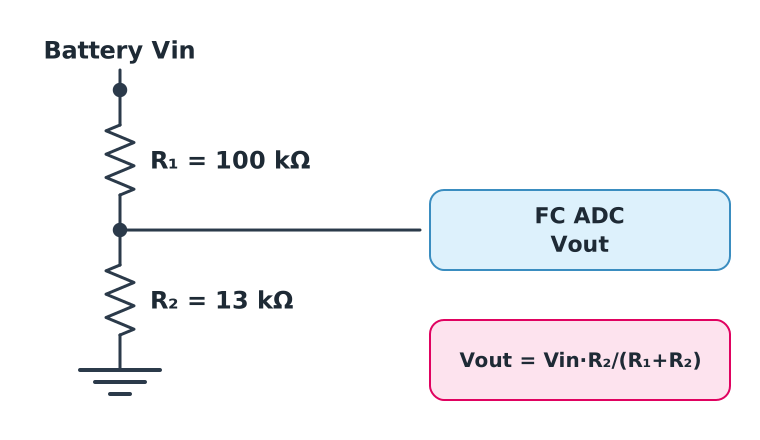
Example 4. Sensing a 6S battery
A fully charged 6S battery is at V. With kΩ and kΩ:
That is below 3.3 V, so it is safe. Software multiplies back by to display the real voltage. In ArduPilot this is the battery monitor’s voltage-multiplier parameter; set it wrongly and low-battery warnings fire at the wrong time.
Battery cell arrangements
Lithium packs are built from cells and labelled with S (series) and P (parallel):
- In series, voltages add and capacity stays the same.
- In parallel, capacities add and voltage stays the same.
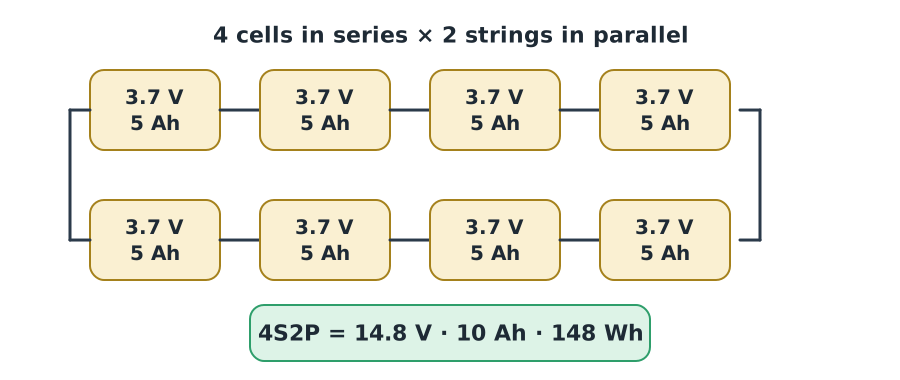
Example 5. A 4S2P battery
Eight 3.7 V 5 Ah cells arranged 4S2P:
- Voltage V
- Capacity Ah
- Energy Wh
In series, a cell with lower voltage than the others empties first and can be over-discharged and damaged. A balance charger therefore measures and equalises each cell through the balance lead.
Module lab
In class
- Build series and parallel circuits with three resistors. Measure voltage and current everywhere and check KCL and KVL from your readings.
- Design a voltage divider for a 4S battery giving at most 3.3 V. Build it on a breadboard, feed it from a supply instead of a battery and compare with your calculation.
- Check a sample battery with a cell checker. Record each cell voltage and find the largest difference.
Common mistakes
Watch out
- Adding parallel resistances directly. Use reciprocals.
- Reversing the divider. Swapping and gives too high a voltage and can destroy the ADC.
- Mixing up S and P. Series raises voltage; parallel raises capacity.
- Forgetting that main leads carry the total current of everything in parallel.
Summary
- Series: resistances add, current is the same. Parallel: reciprocals add, voltage is the same.
- KCL: current in equals current out at a junction. KVL: voltages around a loop sum to zero.
- A voltage divider lets an ADC measure high voltage.
- An xSyP pack multiplies voltage by S and capacity by P, and needs balance charging.
Check your understanding
- Three 30 Ω resistors are in parallel. What is the total resistance?
- A 9 V battery is in series with 1 kΩ and 2 kΩ. What is the voltage across 2 kΩ?
- At a junction, 5 A and 3 A flow in and 6 A flows out one branch. What flows out the other?
- What energy does a 6S1P pack of 3.7 V 4 Ah cells store?
- A divider with kΩ and kΩ has V. What is ?
Answers
- Current mA; voltage V
- A
- Wh
- V
Key formulas
| Series | |
| Parallel | |
| Two in parallel | |
| Kirchhoff's current law (KCL) | |
| Kirchhoff's voltage law (KVL) | |
| Voltage divider |
Key references
Further reading
Study the assigned knowledge units in advance, review media and take the module quiz
DC and AC electrical circuits
Designing and integrating drone systems
In class / field
Lab or field practice from worksheets with a safety checklist
Learning evidence: Checked worksheets and quiz results