Electrical quantities and Ohm's law
DRT 113 Fundamentals of Electrical and Electronics
Lesson
By the end of this module you will be able to
- Explain charge, current, voltage and resistance and how they relate
- Use Ohm's law and all three forms of the power equation to analyse DC circuits
- Calculate wire resistance from resistivity, length and cross-sectional area
- Assess voltage drop and power loss in drone wiring
- Choose suitable power ratings for resistors and fuses
Electricity is a drone’s circulation system
Everything on a drone runs on electricity. The battery feeds energy through wires to the ESCs, motors, flight controller, camera and radios. Wire that is too thin runs hot and drops voltage; a reversed connection can destroy expensive equipment instantly. Understanding basic electrical quantities is therefore a matter of both efficiency and safety.
This course moves from fundamentals to real devices. The first module starts with the four quantities used throughout: charge, current, voltage and resistance.
Charge, current and voltage
Electric charge (, in coulombs, C) is a property of particles; electrons carry negative charge. In metals such as copper some electrons move freely, which is why metals conduct well.
Electric current (, in amperes, A) is the rate at which charge flows past a point:
A current of 1 A is 1 C passing each second, so a 5 Ah battery holds C. In circuit work we use conventional current, flowing from positive to negative outside the source, the opposite of the electrons’ actual motion.
Voltage (, in volts, V) is the energy per unit charge that a source gives to charge, or that charge gives up passing through a component. In a water analogy, voltage is like the pressure from a raised tank, current is the volume of water flowing each second, and resistance is a narrow pipe.
Key idea
Voltage is always measured between two points; current is measured at a point in the path. This difference decides how meters are connected in Module 5.
Resistance and Ohm’s law
Resistance (, in ohms, Ω) is how hard it is for current to flow. For many materials at constant temperature, current is proportional to voltage. This is Ohm’s law:
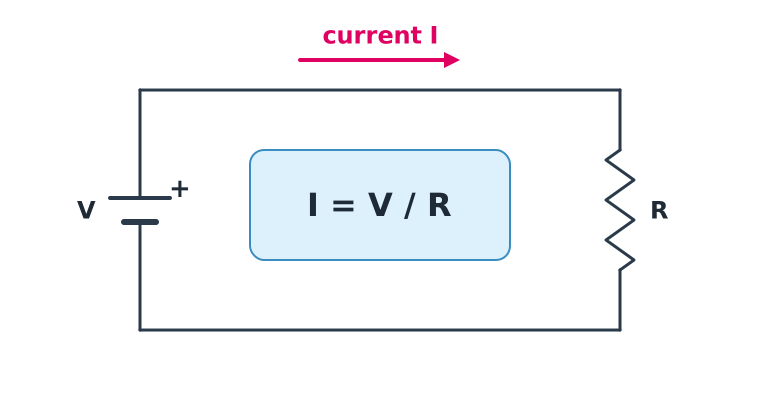
It can be rearranged three ways depending on what you need: , and .
Example 1. A drone status LED
An LED on a 5 V supply drops 2.0 V and needs 15 mA. What current-limiting resistor is required?
The resistor must take V, so
Power and energy
Electrical power is the rate of energy use, in watts (W). Combined with Ohm’s law it can be written three ways:
Use whichever form contains the values you know. Energy is power times time, , in joules or watt-hours (). The 74 Wh battery from DRT 111 therefore stores J.
Resistor power ratings
A resistor turns electrical energy into heat, so it has a power rating such as 0.25 W or 5 W. Exceed it and the resistor overheats and burns. A common practice is to choose at least twice the calculated power.
Example 2. A test resistor
A 10 Ω resistor is connected to 5 V.
- Current A
- Power W
- Choose a resistor rated at least 5 W
The resistor in Example 1 dissipates only W, so an ordinary 0.25 W part is fine.
Wire resistance
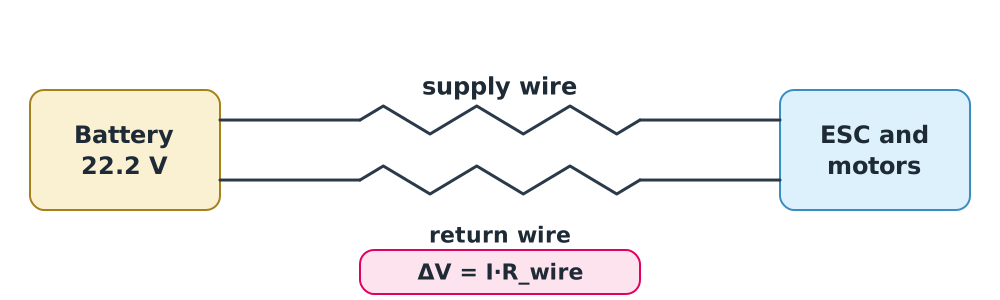
Wires have resistance too, though very little. It depends on material, length and cross-sectional area:
where is the material’s resistivity; copper at 20 °C is about . Longer wire has more resistance; thicker wire has less.
Example 3. A drone’s main power leads
The main leads from battery to ESC are 0.3 m each (0.6 m out and back), 14 AWG with 2.08 mm² cross-section, carrying 30 A at full power.
- Voltage drop V
- Power lost as heat W
These look small, but halve the wire area or double its length and the heat doubles. Loose connectors or poor solder joints often have more resistance than the wire itself.
Fuses and overcurrent protection
A fuse is a deliberate weak point designed to open when current exceeds a set value, protecting wiring and equipment from heat and fire. Its rating must be above normal operating current but below what the wiring can carry. For bench testing, a smoke stopper limits current at first power-up: if there is a short, its lamp or fuse takes the load instead of the real circuit.
Module lab
In class
- Connect an adjustable supply to a 100 Ω resistor. Vary voltage from 1 to 10 V, record current and plot against . Compare the slope with .
- Build the LED circuit from Example 1 and measure the actual current.
- With a current-limited supply, pass 10 A through 1 m lengths of different wire gauges, measure the voltage drop across each and compare the resistance with the formula.
Safety. Set the supply’s current limit before connecting any circuit. Do not touch power resistors in operation; they get very hot.
Common mistakes
Watch out
- Using mA in formulas without converting. 15 mA is 0.015 A.
- Confusing power with energy. Watts are a rate; watt-hours are an amount.
- Forgetting the return wire. Wire length for voltage drop includes both directions.
- Choosing resistors by ohms alone. Check the power rating too.
Summary
- Current is the rate of charge flow, ; voltage is energy per charge; resistance is opposition to current.
- Ohm’s law and power .
- Wire resistance causes voltage drop and heat, especially at high current.
- Choose resistor and fuse ratings carefully, and use a smoke stopper at first power-up.
Check your understanding
- A current of 2 A flows for 30 s. How much charge passes?
- A 47 Ω resistor carries 0.2 A. What is the voltage across it?
- A 12 V heater draws 36 W. What is its resistance?
- What is the resistance of 2 m of copper wire with a 1 mm² cross-section?
- If current in a wire doubles, by what factor does the heat in the wire change?
Answers
- C
- V
- , so it rises 4 times
Key formulas
| Current | |
| Ohm's law | |
| Electrical power | |
| Conductor resistance | |
| Electrical energy |
Key references
- Ling, S. J., Sanny, J., & Moebs, W. (2016). University physics volume 2. OpenStax. link
- Boylestad, R. L., & Nashelsky, L. (2013). Electronic devices and circuit theory (11th ed.). Pearson.
- Horowitz, P., & Hill, W. (2015). The art of electronics (3rd ed.). Cambridge University Press.
Further reading
Study the assigned knowledge units in advance, review media and take the module quiz
In class / field
Lab or field practice from worksheets with a safety checklist
Learning evidence: Checked worksheets and quiz results