Intelligent control
DRT 344 Automation, Robotics and Intelligent Control Systems
Lesson
By the end of this module you will be able to
- Explain the perceive, understand, plan and control loop of autonomous systems
- Explain levels of automation and the role of human oversight
- Compare the Dijkstra, A* and RRT path-planning algorithms
- Calculate the output of a simple fuzzy controller
- Explain the principles of MPC and reinforcement learning and their safety limits
Why this matters
The PID controller of module 3 keeps a drone where it is told to be, but who decides where it should go? What if a tree is in the way, the target moves, or the data are uncertain? Advanced automated systems must perceive their environment, plan and decide for themselves. Together this is called intelligent control and autonomy.
Think of a driver. PID is the skill of steering within the lane; intelligent control is reading signs, choosing a route and deciding to brake when someone steps into the road.
The autonomy loop
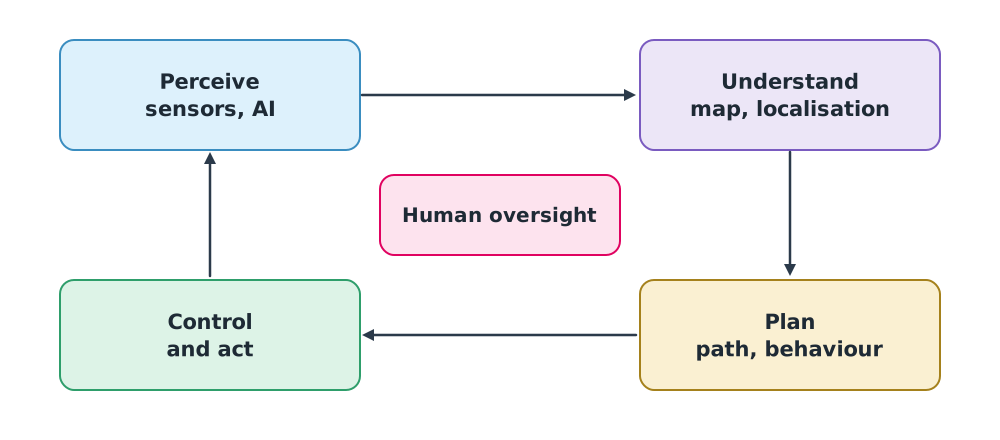
- Perceive: read sensors and use AI to detect objects
- Understand: build a map and localise
- Plan: choose a path and behaviour
- Control: command low-level controllers such as PID to follow the plan
Every step carries uncertainty, and a perception error propagates through every later step. A good system therefore has human oversight at a level appropriate to the risk.
Levels of automation
Autonomy is not just “piloted” versus “flies itself”; there are many levels. Useful reference frameworks include:
- NIST ALFUS (Autonomy Levels for Unmanned Systems, SP 1011), which characterises unmanned-system autonomy by mission complexity, environmental difficulty and the degree of reliance on humans
- SAE J3016, which divides road-vehicle driving automation into levels 0–5, from no automation to full automation. It is a helpful analogy, though not designed for drones
The key questions at each level are who is accountable when the system decides wrongly, and does the human know in time when to intervene (linking to ethics in DRT 343 module 5).
Path planning
A grid map divides space into cells; obstacle cells cannot be entered. Search algorithms find a path from start S to goal G.
- Dijkstra (1959) expands nodes in order of accumulated cost from the start, . It guarantees the shortest path but searches in every direction
- A* (Hart, Nilsson & Raphael, 1968) uses , where estimates the remaining distance to the goal. If never overestimates, A* still finds the shortest path while expanding far fewer nodes
- RRT (LaValle, 1998) randomly grows a tree of paths through the space. It suits continuous, high-dimensional spaces such as a drone in 3D, but its paths are usually not shortest and need smoothing afterwards
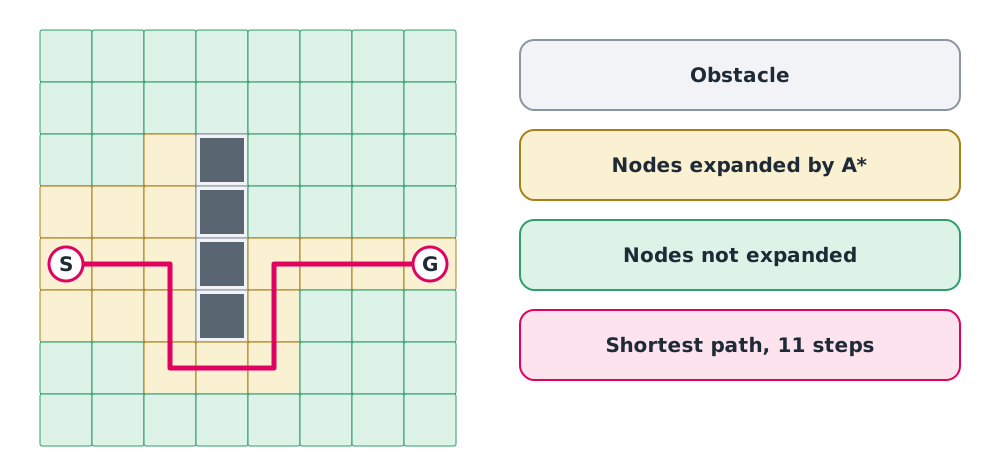
Example 1 A* versus Dijkstra
An 8×8 grid, 4-connected, 1 unit per step, with a vertical wall of 4 cells between S and G, using Manhattan distance as the heuristic.
- At the start , but the wall blocks the straight route, so the real path must detour
- Results from a Python program: both methods find a path of 11 steps
- Dijkstra expands 59 nodes; A* expands only 18
A good heuristic greatly reduces computation, which matters on a drone’s limited onboard computer that must replan whenever it finds a new obstacle.
Fuzzy control
Zadeh’s (1965) fuzzy logic gives set membership values between 0 and 1 instead of yes or no. Mamdani and Assilian (1975) used it to build controllers from human-language rules such as “if far from the target, fly fast”.
Example 2 A simple fuzzy speed controller
Rules: if the distance is near, fly at 2 m/s; if far, fly at 8 m/s. Over 0–10 m, let and . The drone is now m from the target.
- and
- m/s
The speed changes smoothly with distance instead of jumping from 2 to 8 m/s at a single boundary.
MPC and reinforcement learning
- Model predictive control (MPC) uses a model to predict the system over a horizon and finds the best commands subject to constraints, such as maximum speed or area boundaries. It applies the first command and recomputes every cycle. Its strength is handling constraints directly; its cost is heavy computation
- Reinforcement learning (RL) lets an agent learn a policy by trial and error to maximise reward (Sutton & Barto, 2018). A landmark example: Kaufmann et al. (2023) trained a racing drone with deep RL that beat human champions on a test course, training mostly in simulation
Learning systems carry a particular risk: they work well in conditions they were trained on but are hard to predict in unfamiliar ones. Real deployment needs verifiable protection layers, such as geofences and non-AI failsafes (DRT 342 module 2), SITL testing first, and human oversight.
Class activity
Activity: Planning a path and testing in simulation
- Implement A* on a grid in Python, move the obstacles, and compare the nodes expanded with Dijkstra.
- Try an overestimating heuristic such as and check whether the path is still shortest.
- Design fuzzy rules to slow down when approaching an obstacle.
- Discuss which protection layers an AI avoidance system needs before real flight, drawing on the SITL knowledge unit in the drone knowledge hub.
Common mistakes
Watch out
- Using an overestimating heuristic and assuming the path is still shortest
- Planning on an old map without replanning when obstacles appear
- Trusting AI output without verifiable protection layers
- Misreading levels of automation as meaning an autonomous system needs no accountable person
- Deploying an RL policy trained in simulation directly without testing the sim-to-real gap
Summary
- Autonomous systems run a loop of perceive → understand → plan → control, with human oversight
- Autonomy has many levels; NIST ALFUS and SAE J3016 are reference frameworks
- A* uses , finds the same shortest path as Dijkstra while expanding fewer nodes; RRT suits continuous high-dimensional spaces
- Fuzzy control uses human-language rules with membership 0–1; MPC handles constraints directly
- RL can achieve remarkable results but needs verifiable protection before real use
Check your understanding
- In A*, what do and mean?
- What is the Manhattan distance from to the goal on a grid?
- In the fuzzy example, what speed is commanded at 3 m?
- What is the main advantage of MPC over PID?
- Why does an AI avoidance system still need a geofence and non-AI failsafes?
Answers
- is the actual cost from the start to node ; estimates the remaining cost from to the goal
- , , so m/s
- MPC predicts the future with a model and handles constraints directly
- AI may fail in conditions it was not trained on, so verifiable, predictable protection layers are required
Key formulas
| A* evaluation function | |
| Manhattan distance (4-connected grid heuristic) | |
| Weighted average (simple defuzzification) |
Key references
- Huang, H.-M. (Ed.). (2008). Autonomy levels for unmanned systems (ALFUS) framework, Volume I: Terminology, Version 2.0 (NIST SP 1011-I-2.0). NIST. link
- SAE International. (2021). Taxonomy and definitions for terms related to driving automation systems for on-road motor vehicles (J3016_202104). link
- Dijkstra, E. W. (1959). A note on two problems in connexion with graphs. Numerische Mathematik, 1, 269–271. link
- Hart, P. E., Nilsson, N. J., & Raphael, B. (1968). A formal basis for the heuristic determination of minimum cost paths. IEEE Transactions on Systems Science and Cybernetics, 4(2), 100–107. link
- LaValle, S. M. (1998). Rapidly-exploring random trees: A new tool for path planning (TR 98-11). Iowa State University. link
- Zadeh, L. A. (1965). Fuzzy sets. Information and Control, 8(3), 338–353. link
- Mamdani, E. H., & Assilian, S. (1975). An experiment in linguistic synthesis with a fuzzy logic controller. International Journal of Man-Machine Studies, 7(1), 1–13. link
- Rawlings, J. B., Mayne, D. Q., & Diehl, M. M. (2017). Model predictive control: Theory, computation, and design (2nd ed.). Nob Hill Publishing. link
- Sutton, R. S., & Barto, A. G. (2018). Reinforcement learning: An introduction (2nd ed.). MIT Press. link
- Kaufmann, E., Bauersfeld, L., Loquercio, A., Müller, M., Koltun, V., & Scaramuzza, D. (2023). Champion-level drone racing using deep reinforcement learning. Nature, 620, 982–987. link
- Siegwart, R., Nourbakhsh, I. R., & Scaramuzza, D. (2011). Introduction to autonomous mobile robots (2nd ed.). MIT Press.
- Thrun, S., Burgard, W., & Fox, D. (2005). Probabilistic robotics. MIT Press.
Further reading
Study the assigned knowledge units in advance, review media and take the module quiz
Autonomous path planning and obstacle avoidance
Topic 2: AI and automated control
Developing simulations and connecting SITL
In class / field
Lecture, case discussion and in-class problem solving
Learning evidence: Quiz results and submitted exercises