Risk and contingencies
DRT 342 Mission Planning, Autonomous Operations and Beyond Visual Line of Sight
Lesson
By the end of this module you will be able to
- Explain the operational risk management (ORM) cycle and separate hazard, risk, mitigation and evidence
- Explain the ten steps of SORA 2.5 and the meaning of GRC, ARC, SAIL and OSO
- Determine iGRC, final GRC and SAIL from the SORA 2.5 tables for an exercise case
- Distinguish normal, contingency and emergency situations and relate them to the operational area
- Write contingency procedures and an emergency response plan for a mission
Why this matters
No mission has zero risk. The real question is whether the remaining risk is acceptable, and what evidence shows it. For flights that depart from the general conditions, the 2026 CAAT notification requires a risk assessment and authorisation before flight, and CAAT may ask for the operations manual, the risk-management manual and additional safety measures. Risk assessment is therefore not paperwork; it is a condition for being allowed to fly.
Risk is like crossing a road. The hazard is traffic. The risk depends on how often and how fast cars come. The mitigations are a zebra crossing and traffic lights. The evidence is that the lights actually work and cars actually stop. Writing “there is a zebra crossing” does not by itself make anyone safe.
The operational risk management cycle
Operational risk management (ORM) is a cycle repeated for every mission:
- Identify hazards: things that could cause harm, such as people walking into the launch site, gusts or a degraded battery
- Assess risk: likelihood multiplied by severity
- Set mitigations that reduce likelihood, severity or both, each with an owner
- Decide whether the residual risk is acceptable under the organisation’s criteria
- Monitor and review: are the mitigations working, and has anything changed?
Example 1 The course risk matrix
This course uses a 5×5 example matrix with : 1–4 low, 5–9 medium, 10–25 high (real organisations use their own criteria in their OM).
Hazard: people pass the launch site next to a public footpath. Likelihood , severity .
- , high
- Mitigation: move the launch site inside a cordoned area and station one marshal with authority to stop the operation
- Reassess: , gives , low
A mitigation may lower the score only when there is evidence that it works, such as photos of the cordon on the day and a record that the marshal was in place throughout. Without evidence, keep the original score and record an evidence gap.
The SORA 2.5 method
JARUS SORA (Specific Operations Risk Assessment) is a risk assessment method for specific-category operations that many countries use or adapt. Edition 2.5 was released on 13 May 2024 and has ten steps.
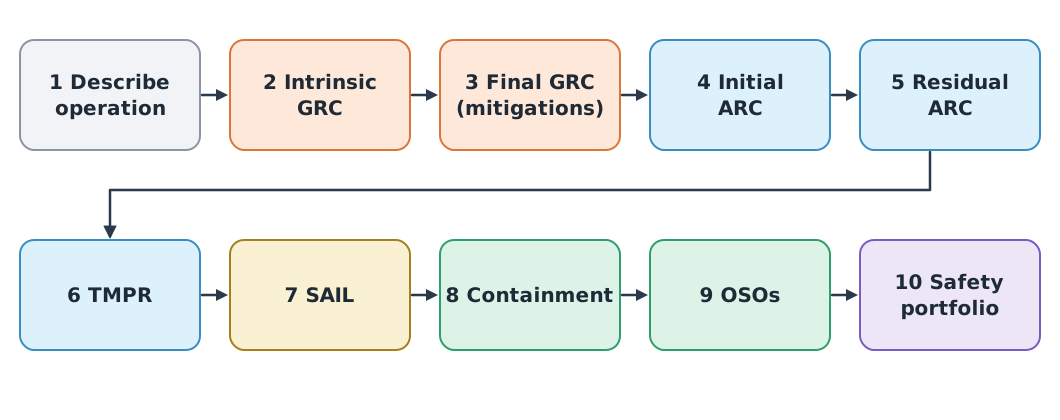
| Term | Meaning |
|---|---|
| GRC (Ground Risk Class) | Risk to people on the ground. iGRC is before mitigation; final GRC is after |
| ARC (Air Risk Class) | Risk of collision with crewed aircraft, ARC-a to ARC-d |
| TMPR | Tactical mitigation performance requirement for air risk, such as DAA |
| SAIL | Level of confidence that the operation stays under control, I to VI |
| OSO | Operational safety objectives, 17 in total; the required robustness of evidence rises with SAIL |
| Containment | Requirements that keep the aircraft from escaping and creating risk in the adjacent area |
Step 2: find the iGRC
Use Table 2 of SORA 2.5. Choose the left-most column that covers both the maximum characteristic dimension and the maximum speed of the aircraft, and the row for the highest population density in the footprint (operational volume plus ground risk buffer).
| Max population density (people/km²) | ≤1 m / 25 m/s | ≤3 m / 35 m/s | ≤8 m / 75 m/s | ≤20 m / 120 m/s | ≤40 m / 200 m/s |
|---|---|---|---|---|---|
| Controlled ground area | 1 | 1 | 2 | 3 | 3 |
| < 5 | 2 | 3 | 4 | 5 | 6 |
| < 50 | 3 | 4 | 5 | 6 | 7 |
| < 500 | 4 | 5 | 6 | 7 | 8 |
| < 5,000 | 5 | 6 | 7 | 8 | 9 |
| < 50,000 | 6 | 7 | 8 | 9 | 10 |
| > 50,000 | 7 | 8 | Not part of SORA | Not part of SORA | Not part of SORA |
Step 3: GRC mitigations
| Mitigation | Low | Medium | High |
|---|---|---|---|
| M1(A) Sheltering | −1 | −2 | – |
| M1(B) Operational restrictions | – | −1 | −2 |
| M1(C) Ground observation | −1 | – | – |
| M2 Reduced impact effects, e.g. parachute | – | −1 | −2 |
Low, medium and high are levels of robustness of evidence defined in Annex B, not levels you may choose freely. When all M1 mitigations are applied, the final GRC cannot be lower than the lowest value in the applicable column, because the number of people at risk cannot fall below that of a controlled ground area.
Step 7: find the SAIL
| Final GRC | ARC-a | ARC-b | ARC-c | ARC-d |
|---|---|---|---|---|
| ≤2 | I | II | IV | VI |
| 3 | II | II | IV | VI |
| 4 | III | III | IV | VI |
| 5 | IV | IV | IV | VI |
| 6 | V | V | V | VI |
| 7 | VI | VI | VI | VI |
| >7 | Certified category |
Example 2 Working through the SORA tables (exercise case)
A multirotor with a maximum dimension of 1.2 m and maximum speed of 20 m/s flies over an area whose highest density in the footprint is below 500 people/km². Assume the air-risk assessment gives a residual ARC-b.
- At 1.2 m it exceeds 1 m, so use the ≤3 m / 35 m/s column; the < 500 row gives iGRC = 5
- Assume low-robustness evidence for M1(A) sheltering: . The column minimum is 1, so final GRC = 4
- GRC 4 with ARC-b gives SAIL III
This example is for practising table reading. In real work, mitigations must be substantiated under SORA Annex B, reviewed by experts and accepted by the regulator. Never guess GRC, ARC or SAIL values for an application.
Normal, contingency and emergency
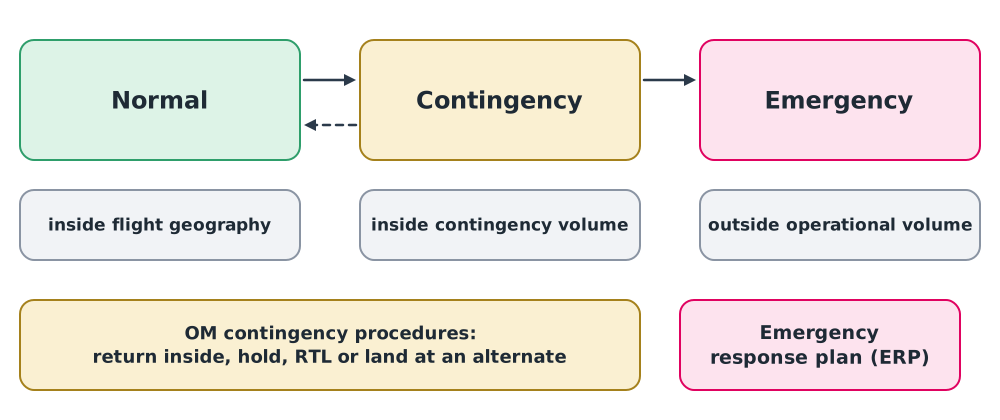
SORA and operations manuals distinguish three situations, which match the layers of the operational area from module 1.
| Situation | Condition | Action |
|---|---|---|
| Normal | Inside the flight geography; systems working as planned | Fly the mission and monitor |
| Contingency | An abnormal event, or outside the flight geography but still inside the contingency volume | Apply contingency procedures such as hold, RTL or land at an alternate to return to normal |
| Emergency | Outside the operational volume or loss of control | Apply emergency procedures such as flight termination, and start the emergency response plan (ERP) |
Classify the symptom before choosing a procedure
One symptom does not confirm one cause (review the knowledge unit on classifying abnormal events). A jumping position on the map could come from GNSS interference or from the GCS display. OM procedures must start by checking what can be confirmed, then choose the response prepared in advance, rather than inventing one in the air.
Emergency response plan (ERP)
The ERP is what the team does after a serious event, such as the drone coming down outside the area. It should cover at least:
- The person in charge and the contact list, such as rescue services, police, the landowner and the regulator as the law requires
- How to reach and cordon the crash site and care for anyone injured
- Handling damaged lithium batteries, which can catch fire later
- Preserving logs and evidence for investigation
- Regular rehearsal of the plan
Class activity
Activity: Risk matrix with evidence
Use exercise B02 “Evidence-based risk assessment” from the drone knowledge hub, building on your group mission from module 3.
- Put hazard, effect, mitigation and evidence in separate columns, and mark each piece of evidence as observed, documented or pending.
- Work through the SORA 2.5 tables to find iGRC and SAIL for the exercise case, stating clearly which values are assumptions.
- Write contingency procedures for three events: C2 link loss, battery below threshold, and a person entering the area.
- Draft a one-page ERP.
Review the claims “an AI camera makes it safe” and “the fence on the map means nobody enters”. What evidence is missing?
Common mistakes
Watch out
- Writing a mitigation’s name and lowering the score at once without evidence that it works
- Guessing GRC, ARC or SAIL without population and airspace data
- Using average density instead of the highest density in the footprint
- Reducing GRC below the column minimum
- Having only emergency procedures and no contingency procedures, so every event becomes an emergency
- Borrowing another organisation’s risk matrix without understanding its levels
Summary
- ORM is identify hazards, assess, mitigate, decide and monitor; every mitigation needs an owner and evidence
- SORA 2.5 has ten steps. It combines ground risk (GRC) and air risk (ARC) into a SAIL, which sets the robustness of evidence for the 17 OSOs
- iGRC comes from the left-most column that covers both dimension and speed, and the highest-density row; the final GRC cannot go below the column minimum
- Situations are normal, contingency and emergency, matching flight geography, contingency volume and outside the operational volume
- The ERP sets what the team does after a serious event and must be rehearsed
Check your understanding
- How does a hazard differ from a risk?
- A drone with a 0.9 m maximum dimension and 18 m/s maximum speed flies over an area with density below 50 people/km². What is the iGRC?
- What SAIL results from final GRC 5 and residual ARC-c?
- An iGRC of 2 in the ≤1 m column is reduced by medium-robustness M1(A) (−2). What is the final GRC?
- A gust pushes the drone out of the flight geography but it is still inside the contingency volume. Which situation is this, and what should be done?
Answers
- A hazard is something that could cause harm; risk combines the likelihood and severity of harm from that hazard
- Column ≤1 m / 25 m/s, row < 50: iGRC = 3
- SAIL IV
- , but it cannot fall below the ≤1 m column minimum of 1, so final GRC = 1
- Contingency. Apply the OM contingency procedures, such as bringing it back into the flight geography, hold or RTL, and record the event
Key formulas
| Risk level in a matrix (course example) | |
| GRC after M1 mitigations | |
| SAIL |
Key references
- Joint Authorities for Rulemaking on Unmanned Systems. (2024). JARUS guidelines on Specific Operations Risk Assessment (SORA), main body, edition 2.5 (JAR-DEL-SRM-SORA-MB-2.5). link
- International Organization for Standardization. (2023). Unmanned aircraft systems – Part 3: Operational procedures (ISO 21384-3:2023). link
- สำนักงานการบินพลเรือนแห่งประเทศไทย. (2565). รูปแบบคู่มือปฏิบัติการบินของอากาศยานซึ่งไม่มีนักบิน (CAAT-GM-UAS-001, Issue 01 Rev 00). link
- สำนักงานการบินพลเรือนแห่งประเทศไทย. (2569). ประกาศ กพท. เรื่อง หลักเกณฑ์และวิธีการในการอนุญาตให้ผู้บังคับหรือปล่อยอากาศยานซึ่งไม่มีนักบิน ประเภทอากาศยานที่ควบคุมการบินจากภายนอก ที่มีน้ำหนักไม่เกิน 25 กิโลกรัม ปฏิบัติแตกต่างไปจากเงื่อนไขที่กำหนด พ.ศ. 2569 (มีผล 17 พฤษภาคม 2569). link
- International Civil Aviation Organization. (2015). Manual on remotely piloted aircraft systems (RPAS) (Doc 10019). ICAO. link
- European Commission. (2019). Commission Implementing Regulation (EU) 2019/947 on the rules and procedures for the operation of unmanned aircraft. link
Further reading
Study the assigned knowledge units in advance, review media and take the module quiz
The SORA methodology
Evidence-based risk assessment
Diagnosing abnormal events before choosing a response
In class / field
Lecture, case discussion and in-class problem solving
Learning evidence: Quiz results and submitted exercises