Technology trends
DRT 341 Advanced Unmanned Aircraft Systems Technology and System Architecture
Lesson
By the end of this module you will be able to
- Explain key UAS technology trends including autonomy, onboard AI, swarms, BVLOS, UTM and new energy sources
- Use technology readiness levels (TRL) to assess new technologies systematically
- Separate marketing claims from evidence of operational readiness
- Relate technology trends to regulation and the Thai context
- Propose a risk-appropriate approach to adopting new technology in an organisation
Drone technology moves faster than textbooks
Much of what was innovation five years ago is standard today, and much of what is announced at this year’s trade shows is not yet ready for real use. UAS professionals need two skills: tracking trends and assessing readiness on evidence, so their organisations invest neither too early nor too late.
Drone-Hub has an in-depth article on the drone technology landscape, researched from academic work and open-source projects. Read it alongside this module.
Key trends
- Autonomy and onboard AI: object detection, obstacle avoidance and some decisions move from the ground station to the aircraft (edge AI), reducing reliance on the link.
- Automated docks (drone-in-a-box): drones launch, land and recharge on schedule for routine patrol and inspection.
- Beyond visual line of sight (BVLOS): relies on detect-and-avoid (DAA) and reliable C2 links such as cellular or satellite.
- UAS traffic management (UTM) and Remote ID: digital systems that coordinate many flight paths and let drones be identified from the ground.
- Swarms: from commercial light shows to cooperative search and survey missions.
- New energy sources: hybrid and hydrogen fuel-cell systems for long-endurance missions (Module 2).
- Counter-UAS: detecting, identifying and dealing with unwanted drones, both a market and a legal concern.
Technology readiness levels (TRL)
NASA developed the nine-level TRL scale to assess technology maturity systematically. It is now widely used in aviation, defence and research evaluation.
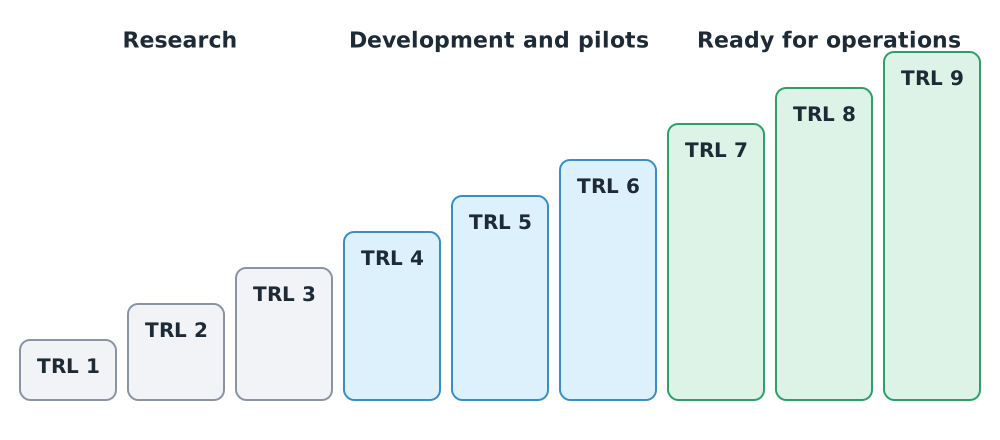
| TRL | Meaning |
|---|---|
| 1 | Basic principles observed and reported |
| 2 | Technology concept or application formulated |
| 3 | Proof of concept by analysis and experiment |
| 4 | Component validated in the laboratory |
| 5 | Component validated in a relevant environment |
| 6 | System or prototype demonstrated in a relevant environment |
| 7 | System prototype demonstrated in an operational environment |
| 8 | Actual system completed and qualified through test |
| 9 | Actual system proven through successful mission operations |
TRL is judged on what has actually been built and tested, not on excitement or funding. The hardest step is usually from the lab (TRL 4) to demonstration in realistic conditions (TRL 6 and above).
Decision guide for this course
This is a thinking aid for the course. Real organisations may set stricter thresholds, especially where people’s safety is involved.
Example 1. Assessing a vendor’s offer
A vendor offers an “AI obstacle-avoidance system ready for urban BVLOS”.
Questions to establish TRL:
- In what environments has it been tested: lab, test range, real city?
- How many flight hours of test data, with what detection and miss rates?
- What regulator has certified or authorised it?
- Do customers use it in real operations?
If the answer is “tested on the company’s range, with demo videos, but not yet authorised for urban use”, the technology is probably around TRL 6: suitable for a pilot in a controlled area, not yet for urban operations.
Example preliminary assessments
This table is a thinking exercise as of 2026. Actual levels depend on each product and use, and change quickly; always check the latest evidence.
| Technology | Approx. TRL | Reason |
|---|---|---|
| Automated docks for patrol | 8–9 | Commercial products in operational use in several countries |
| Drone light-show swarms | 9 | Widely used commercially |
| Cooperative autonomous search swarms | 5–7 | Demonstrated and trialled, not yet common in real missions |
| Hydrogen fuel cells for UAS | 7–8 | Products exist, but fuel infrastructure is limited |
| C2 over 5G networks | 7–8 | Trials and some operational use in certain countries |
The Thai context
A technology is usable only when regulation allows it. The Civil Aviation Authority of Thailand (CAAT) issued criteria for permitting operators of unmanned aircraft up to 25 kg to operate differently from the prescribed conditions, effective 17 May 2026. It classifies flights that depart from the conditions of the 2015 Ministry of Transport notification as “medium-risk operations (Specific Category)”, which require a risk assessment and authorisation before flight. You will study the details in DRT 343, and must always check CAAT’s website for the latest notices.
In practice, Thai organisations should weigh three things together: technology readiness (TRL), regulatory readiness, and readiness of people and maintenance.
Class activity
Case study
- Each group picks one technology from the trends, finds evidence from at least three credible sources, and assesses its TRL with reasons.
- Present an investment proposal to “executives” (instructor and classmates): operate, pilot or wait, and what the risks are.
- Compare advertising claims with the test evidence you can find.
Common mistakes
Watch out
- Assessing TRL from demo videos without asking about test conditions and data.
- Forgetting regulatory readiness: technology ready but not yet legal to use.
- Treating textbook TRL figures as fixed, when they change with time and product.
- Overlooking maintenance and training costs.
Summary
- Key trends: onboard AI, automated docks, BVLOS with DAA, UTM and Remote ID, swarms, new energy sources and counter-UAS.
- NASA’s TRL 1–9 assesses readiness from what has actually been built and tested.
- Use TRL together with test evidence, regulatory readiness and people readiness.
- CAAT’s criteria for operating differently from prescribed conditions (effective 17 May 2026) are a key framework for adopting new technology in Thailand.
Check your understanding
- A technology whose components have been validated in the lab is at which TRL?
- What distinguishes TRL 6 from TRL 7?
- A vendor has only demo videos from its own range. What should you decide under the course guide?
- Besides TRL, which two other kinds of readiness must be considered?
- Name one technology already at TRL 9.
Answers
- TRL 4
- TRL 6 is demonstration in a relevant environment; TRL 7 is in an operational environment
- Judge it around TRL 6: suitable for a controlled pilot, not yet for operations
- Regulatory readiness, and readiness of people and maintenance
- For example, drone light-show swarms
Key formulas
| TRL decision guide (course rule) |
Key references
- National Aeronautics and Space Administration. (2023). Technology readiness levels. link
- International Civil Aviation Organization. (2015). Manual on remotely piloted aircraft systems (RPAS) (Doc 10019). ICAO. link
- U.S. Department of Energy, Fuel Cell Technologies Office. (2017). Target explanation document: Onboard hydrogen storage for light-duty fuel cell vehicles. link
- สำนักงานการบินพลเรือนแห่งประเทศไทย. (2569). ประกาศ กพท. เรื่อง หลักเกณฑ์และวิธีการในการอนุญาตให้ผู้บังคับหรือปล่อยอากาศยานซึ่งไม่มีนักบิน ประเภทอากาศยานที่ควบคุมการบินจากภายนอก ที่มีน้ำหนักไม่เกิน 25 กิโลกรัม ปฏิบัติแตกต่างไปจากเงื่อนไขที่กำหนด พ.ศ. 2569 (มีผล 17 พฤษภาคม 2569). link
- Fahlstrom, P. G., Gleason, T. J., & Sadraey, M. H. (2022). Introduction to UAV systems (5th ed.). Wiley.
Further reading
Study the assigned knowledge units in advance, review media and take the module quiz
In class / field
Lecture, case discussion and in-class problem solving
Learning evidence: Quiz results and submitted exercises