Power and propulsion
DRT 341 Advanced Unmanned Aircraft Systems Technology and System Architecture
Lesson
By the end of this module you will be able to
- Compare multirotor, fixed-wing, hybrid VTOL and helicopter aircraft in energy use and mission fit
- Calculate fixed-wing power required from the lift-to-drag ratio
- Estimate endurance from specific energy and battery mass fraction
- Explain battery-electric, hybrid and fuel-cell propulsion architectures
- Choose a power system to meet mission requirements
Energy decides what a drone can do
The first question users always ask is “how long can it fly?” The answer depends on two things: how much power the aircraft needs to fly and how much energy it can carry. This module compares aircraft types and energy sources so you can choose a system for a mission on sound grounds.
Aircraft types and power use
| Type | Strengths | Limitations | Suited missions |
|---|---|---|---|
| Multirotor | Vertical take-off, hover, easy control | Very high power, short endurance | Close inspection, single-point imaging |
| Fixed-wing | Low power, long endurance and range | Needs a runway or launcher; cannot hover | Wide-area survey, long linear patrols |
| Hybrid VTOL | Vertical take-off plus efficient wing-borne cruise | Complex, heavier from two systems, risky transition | Wide-area survey without a runway |
| Single-rotor helicopter | Better hover efficiency than multirotor, heavy lift | Complex mechanics, heavy maintenance | Agricultural spraying, heavy lift |
The key difference is how lift is produced. A multirotor must push air down continuously to support its weight (see momentum theory in DRT 112). A fixed-wing aircraft gets lift from forward motion, so its propeller only has to overcome drag.
Fixed-wing power required
In level flight, lift equals weight and thrust equals drag. The lift-to-drag ratio () measures wing efficiency, so
Example 1. Comparing power use
A 3 kg fixed-wing aircraft with flies at 15 m/s.
- Drag N
- Mechanical power W
- With combined propeller and motor efficiency 0.6, electrical power W
Compare the 2 kg multirotor using about 237 W in hover (DRT 112 Module 4): the heavier fixed-wing uses roughly a third of the power. That is why wide-area survey favours fixed-wing or VTOL aircraft.
Energy sources
Specific energy () is energy per unit mass, in Wh/kg. The higher it is, the more energy you carry for the same weight.
| Energy source | Approximate specific energy | Note |
|---|---|---|
| LiPo battery (whole pack) | about 150–200 Wh/kg | Delivers high current well; common in multirotors |
| Li-ion battery (whole pack) | about 200–250 Wh/kg | More energy but lower current capability; suits fixed-wing |
| Gasoline (fuel only) | about 12 000 Wh/kg | Small engines convert only a small share to work |
| Hydrogen (fuel only) | about 33 300 Wh/kg | High-pressure tanks are heavy and bulky |
The hydrogen and gasoline figures are lower heating values from U.S. Department of Energy documents. They look far higher than batteries, but the comparison needs care: they are fuel only, excluding engines, tanks and conversion efficiency. At system level the gap narrows a lot; hydrogen’s advantage is clearest on missions lasting several hours.
Estimating endurance from battery mass
where is battery mass, specific energy and the usable fraction (often set to 0.8).
Example 2. Fixed-wing endurance
The aircraft in Example 1 carries a 1.0 kg Li-ion pack at 200 Wh/kg.
- Energy Wh
- Endurance hours
Raise the battery to 1.5 kg and total mass rises, so power required rises too; endurance does not grow by 50%. Designers must find a balanced battery mass fraction.
Propulsion architectures
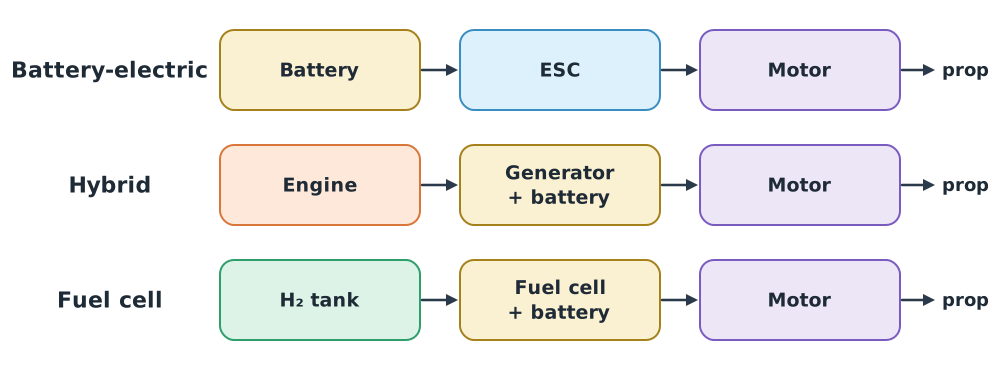
- Battery-electric is simple, quiet and low-maintenance, the most common type, but limited by battery specific energy.
- Hybrid uses an engine to drive a generator; the battery supplies peak power for take-off. Endurance is far longer, at the cost of noise, vibration and engine maintenance.
- Hydrogen fuel cell converts hydrogen straight to electricity, quietly and for long durations, but requires handling high-pressure tanks and a hydrogen supply, with its own safety requirements.
Power-system compatibility
When choosing power-system parts, check several things together:
- Voltage: battery, ESC and motor must support the same cell count.
- Current: ESCs and wiring must carry peak current with margin, and the battery must deliver it (C-rating).
- Thrust: enough thrust-to-weight for control and wind.
- Heat: ESCs, motors and battery must shed heat in Thailand’s hot climate.
- Weight and centre of gravity of the installed system.
Class activity
Case study
- Compare the specifications of three survey drones (multirotor, fixed-wing, VTOL) from maker documents. Calculate area surveyed per flight at equal GSD.
- Using eCalc or a spreadsheet, estimate endurance as battery mass varies from 0.5 to 2.0 kg, and find where gains start to shrink.
- Discuss whether your organisation should invest in hydrogen drones, considering fuel supply, safety and lifecycle cost.
Common mistakes
Watch out
- Comparing fuel specific energy directly with whole battery packs, ignoring system weight and conversion efficiency.
- Assuming endurance grows in proportion to battery added.
- Choosing aircraft type from familiarity rather than mission requirements.
- Forgetting heat in hot weather.
Summary
- Multirotors use high power because rotors support the weight continuously; fixed-wing power is much lower.
- VTOL combines both strengths at the cost of complexity and weight.
- Battery packs offer about 150–250 Wh/kg; fuels are far higher but must be assessed at system level.
- Endurance , and extra battery gives diminishing returns.
- Power systems must match in voltage, current, thrust, heat and centre of gravity.
Check your understanding
- A 5 kg aircraft with flies at 18 m/s. What mechanical power does it need?
- At 0.55 overall efficiency, what electrical power does question 1 need?
- A 1.2 kg battery at 180 Wh/kg, 80% usable, powers question 2. How many minutes can it fly?
- Why is comparing hydrogen’s 33 300 Wh/kg directly with a 200 Wh/kg battery unfair?
- Which aircraft type suits inspecting cracks under a bridge, and why?
Answers
- N, N, W
- W
- Wh, h, about 77 minutes
- The hydrogen figure is fuel only, excluding tank, fuel cell and conversion efficiency
- A multirotor, because it must hover close to the structure and move slowly and precisely
Key formulas
| Level-flight power (fixed-wing) | |
| Electrical power | |
| Battery energy | |
| Endurance |
Key references
- Fahlstrom, P. G., Gleason, T. J., & Sadraey, M. H. (2022). Introduction to UAV systems (5th ed.). Wiley.
- Anderson, J. D. (2016). Introduction to flight (8th ed.). McGraw-Hill.
- Quan, Q. (2017). Introduction to multicopter design and control. Springer.
- U.S. Department of Energy, Fuel Cell Technologies Office. (2017). Target explanation document: Onboard hydrogen storage for light-duty fuel cell vehicles. link
- Leishman, J. G. (2006). Principles of helicopter aerodynamics (2nd ed.). Cambridge University Press.
Further reading
Study the assigned knowledge units in advance, review media and take the module quiz
UAS power distribution systems
BLDC motors, ESCs and propeller matching
In class / field
Lecture, case discussion and in-class problem solving
Learning evidence: Quiz results and submitted exercises