Algebra, functions and units
DRT 111 Applied Mathematics for Technology
Lesson
By the end of this module you will be able to
- Name the SI units and prefixes used most often in drone work and write numbers in scientific notation
- Convert speed, battery capacity and energy units correctly with the factor-label method
- Rearrange an equation to isolate the variable you need
- Explain and apply linear, quadratic, inverse and logarithmic functions to real situations
- Estimate a drone's hover time from battery data and electrical power
Why drone engineers must be precise about numbers and units
Picture this. You are asked to survey a 50-rai (8-hectare) farm plot. Before take-off you need three answers: how long one battery will last, what the speed set in the app means in metres per second, and how much extra thrust you get if you raise the propeller speed a little.
All three questions rely on just three pieces of basic mathematics: units, rearranging equations and functions. This module reviews all three using real drone examples throughout. If you have not used mathematics for a while, you can still follow along. Work through each example step by step as you read.
Key idea
In engineering, a number without a unit has no meaning. “Speed 15” could mean 15 m/s or 15 km/h, a difference of 3.6 times. Mistakes like this can cause a mission to fail or an accident to happen.
Quantities, SI units and prefixes
A quantity is something that can be measured, such as length, time or mass. The value of a quantity is always a number together with a unit, for example 2.5 kg.
The world uses the International System of Units (SI), maintained by the International Bureau of Weights and Measures (BIPM). The SI has seven base units. Five of them appear often in drone work.
| Quantity | Base unit | Symbol |
|---|---|---|
| Length | metre | m |
| Mass | kilogram | kg |
| Time | second | s |
| Electric current | ampere | A |
| Temperature | kelvin | K |
Other units are built from the base units and are called derived units. Force is measured in newtons (), power in watts () and electric potential in volts (V).
Unit prefixes
When a value is very large or very small, we use a prefix instead of writing long strings of zeros.
| Prefix | Symbol | Factor | Drone example |
|---|---|---|---|
| mega | M | 915 MHz radio | |
| kilo | k | 5 km range | |
| milli | m | 5000 mAh battery | |
| micro | µ | 100 µF capacitor | |
| giga | G | 5.8 GHz video link |
Watch the case of the letter. Lower-case m is milli (); upper-case M is mega (). They differ by a factor of one billion.
Scientific notation
Scientific notation writes a number as , where and is an integer. It makes very large and very small numbers easy to read.
A simple rule: if you move the decimal point places to the left, the exponent is ; if you move it places to the right, the exponent is .
Converting units with the factor-label method
The safest way to convert units is the factor-label method. Multiply by fractions equal to 1, such as , and cancel any unit that appears on both top and bottom.
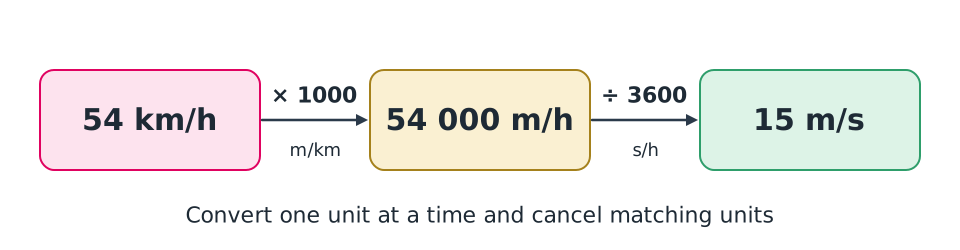
Example 1. Converting a speed
The flight app shows 54 km/h. What is that in m/s?
Because , a handy shortcut is: divide km/h by 3.6 to get m/s, and multiply m/s by 3.6 to get km/h.
Battery units: mAh, Ah and Wh
A LiPo battery label usually gives its charge capacity in mAh (milliampere-hours). 5000 mAh means it can supply 5 A for about one hour. This is not yet energy, because the voltage has not been included.
The energy stored in a battery is measured in watt-hours (Wh):
where is the battery’s nominal voltage and is its capacity in ampere-hours. One LiPo cell has a nominal voltage of 3.7 V. A 4S battery has four cells in series, so its nominal voltage is V.
Example 2. Energy in a battery
How much energy does a 4S 5000 mAh battery store?
- Convert the capacity:
- Calculate the energy:
The Wh figure matters in practice: airlines limit lithium batteries in luggage by Wh, not mAh.
Equations and rearranging formulas
Every formula is an equation. You can rearrange it by doing the same operation to both sides of the equals sign. The aim is to leave the variable you want on its own on one side.
Example 3. Finding current from power
Electrical power is . If all motors together draw 444 W from a 22.2 V battery, what is the total current?
Divide both sides by :
Always check the units: watts divided by volts gives amperes (). If the unit comes out wrong, the rearrangement is wrong.
The dimensional check
Before substituting numbers, check that both sides of the equation have the same unit. This catches almost every mistake. For example, if you write , the unit is , which is not a time, so the formula is upside down. The correct form is .
Functions: relationships between quantities
A function is a rule that pairs each input value () with exactly one output value (), written . Think of a coffee machine: put in one kind of bean and you always get the same coffee out.
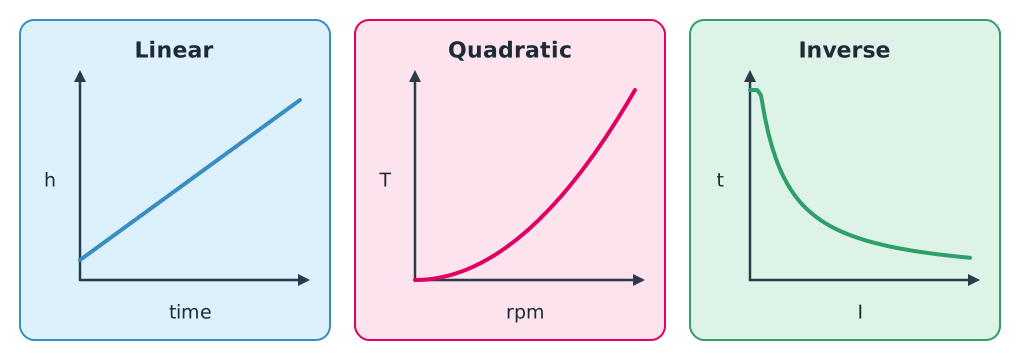
Four kinds of function are common in drone work. Figure 2 shows the shape of the first three.
Linear functions
A linear function has the form , where is the slope or rate of change and is the starting value when .
Example 4. Climbing
A drone hovering at 10 m climbs at 2.5 m/s. Its height as a function of time is
How long does it take to reach 100 m? Solve : , so seconds.
Quadratic functions
Propeller thrust is roughly proportional to the square of rotational speed:
where is thrust, is rotational speed and is a constant that depends on the propeller and air density. In practice this means a small increase in speed gives a larger increase in thrust than you might expect.
Example 5. Increasing speed by 20%
If rotational speed rises from to , the new thrust is
Thrust rises by 44%, not 20%.
Inverse functions
If the battery energy is fixed, run time is inversely proportional to power: . Doubling the power halves the flight time. The graph falls steeply at first and then levels off.
Logarithmic functions and decibels
Radio signal powers can differ by many orders of magnitude, so communication engineers use the decibel (dB), a logarithmic scale:
If signal power halves, dB. You will use this again when calculating link budgets in DRT 227.
Putting it together: estimating hover time
We now have every tool needed to answer the first question of the lesson.
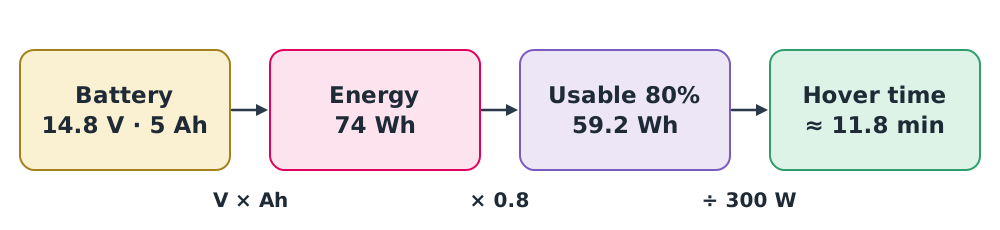
Example 6. Hover time
A drone uses a 4S 5000 mAh battery and draws an average of 300 W while hovering. To protect the battery we use only 80% of its energy ().
- Total energy Wh
- Usable energy Wh
- Time
- In minutes: minutes
This is an estimate. In real conditions, wind, temperature and battery age shorten the flight, so pilots always keep a reserve.
Common mistakes
Watch out
- Confusing mAh with Wh. Charge (mAh) and energy (Wh) are different quantities; multiply by voltage before comparing energy.
- Forgetting to convert mAh to Ah, which puts the answer out by a factor of 1000.
- Mixing up m and M. Milli and mega differ by .
- Assuming everything is linear. Thrust grows with the square of speed, not in direct proportion.
- Not checking the unit of the answer. Every answer needs a unit, and the unit must make sense.
Summary
- A quantity is always a number with a unit. Drone work uses SI units and prefixes such as k, M, m and µ.
- The factor-label method makes conversions reliable. A common shortcut is km/h ÷ 3.6 = m/s.
- Battery energy (Wh) equals voltage times capacity in Ah.
- Rearrange equations by doing the same thing to both sides, then check the unit of the answer.
- Linear, quadratic, inverse and logarithmic functions describe key relationships in drone work, from climbing and thrust to flight time and signal strength.
Check your understanding
Try these before opening the answers.
- What is 20 m/s in km/h?
- How much energy does a 6S (22.2 V) 10 000 mAh battery store?
- Rearrange to find , then find the capacity of a 14.8 V battery storing 96.2 Wh.
- If propeller speed increases by 10%, by what percentage does thrust increase?
- Signal power drops to one quarter. How many dB is that?
Answers
- km/h
- Wh
- Ah, or 6500 mAh
- , so thrust rises by 21%
- dB
Key formulas
| Speed | |
| km/h to m/s | |
| Electrical power | |
| Battery energy | |
| Estimated run time | |
| Linear function | |
| Decibel |
Key references
Further reading
Study the assigned knowledge units in advance, review media and take the module quiz
Derivatives, rates of change and numerical integration
Exercise: coordinates, time and reference levels
In class / field
Lecture, case discussion and in-class problem solving
Learning evidence: Quiz results and submitted exercises