Human factors
DRT 343 Regulations, Safety, Risk Management and Ethics for Unmanned Aircraft Systems
Lesson
By the end of this module you will be able to
- Analyse the interactions between people and systems with the SHELL model
- Identify the twelve human factors of the Dirty Dozen and safeguards in drone work
- Use IMSAFE, PAVE and the 3P model to decide before and during a mission
- Calculate the effect of checklists and cross-checks on error probability
- Explain just culture and the accident-reporting duty under Thai law
Why this matters
Drones are “uncrewed” but not people-free. Every mission has people who plan, configure, fly, observe, maintain and decide, so human error remains a major part of accidents. Human factors studies how people work with machines, procedures, environments and other people, so that work can be designed to make errors harder and to catch them before they cause harm.
It is like driving home late after a hard day. The same person who normally drives well may misjudge because of fatigue, hurry or habit. Laws and technology help, but the rest lies in self-awareness and work systems that warn us.
The SHELL model
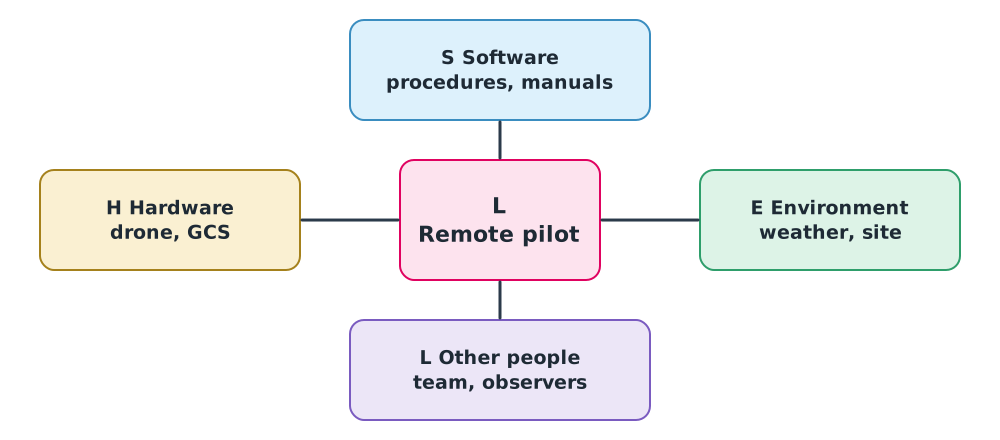
ICAO Doc 9683 describes the SHELL model, proposed by Edwards in 1972 and modified by Hawkins in 1975. The person (Liveware) is at the centre, surrounded by four components that must fit with that person.
| Interface | Example problem in drone work |
|---|---|
| Liveware–Software (L–S) | A long checklist that does not match the aircraft version, so the pilot skips items |
| Liveware–Hardware (L–H) | A GCS screen unreadable in sunlight; RTL and land buttons next to each other |
| Liveware–Environment (L–E) | Heat and noise on site cause early fatigue |
| Liveware–Liveware (L–L) | Observer and pilot use different words for directions |
The twelve human factors (Dirty Dozen)
Transport Canada compiled factors common in maintenance accidents, and FAA handbooks call them the “dirty dozen”. They apply well to drone preparation and flight.
| Factor | Example in drone work | Safeguard |
|---|---|---|
| Lack of communication | Not telling the team the propellers were changed | Handover records and read-back |
| Complacency | “We fly here every day, no need to check” | Use the checklist every time |
| Lack of knowledge | Not knowing new firmware changed failsafe settings | Read release notes; recurrent training |
| Distraction | Someone asks a question during configuration | Pause and restart that step |
| Lack of teamwork | Everyone checks separately; nobody owns the whole | Assign roles in the brief |
| Fatigue | Many sorties in a row in the sun | Build rest into the plan |
| Lack of resources | Not enough spare batteries | Check the equipment list before leaving |
| Pressure | The client is waiting; clouds are building | Set stop criteria in advance |
| Lack of assertiveness | The observer sees a problem but does not speak | Anyone may call a stop |
| Stress | Personal problems affect concentration | Assess readiness before taking duty |
| Lack of awareness | Staring at the screen and missing a person at the launch site | An observer watches the big picture |
| Norms | “Everyone skips this step” | Review the procedure and fix the root cause |
Readiness and decision-making
IMSAFE is a self-check before duty from FAA handbooks: Illness, Medication, Stress, Alcohol, Fatigue and Emotion (some publications use E for Eating). The aim is to expose issues that might be overlooked, not to produce a score that certifies fitness to fly.
The FAA Risk Management Handbook (FAA-H-8083-2A) presents the 3P model for decisions repeated throughout a mission.
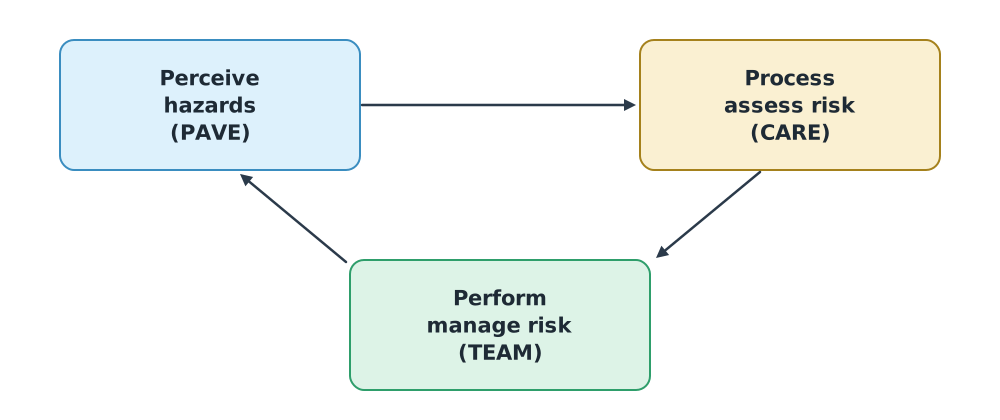
- Perceive hazards with PAVE: Pilot, Aircraft, enVironment, External pressures
- Process with CARE: Consequences, Alternatives, Reality, External factors
- Perform with TEAM: Transfer, Eliminate, Accept, Mitigate
Five hazardous attitudes
| Attitude | Typical thought | Antidote |
|---|---|---|
| Anti-authority | “Don’t tell me.” | “Follow the rules. They are usually right.” |
| Impulsivity | “Do it quickly.” | “Not so fast. Think first.” |
| Invulnerability | “It won’t happen to me.” | “It could happen to me.” |
| Macho | “I can do it.” | “Taking chances is foolish.” |
| Resignation | “What’s the use?” | “I’m not helpless. I can make a difference.” |
Checklists and cross-checks
A checklist does not eliminate error, but it reduces forgotten steps, and a second person’s cross-check catches what slips through. If each step has error probability and independent steps are done, the probability that at least one step is wrong is:
Example 1 The effect of a cross-check (illustrative values)
Assume each step of a pre-flight checklist has error probability and there are 20 steps.
- , so about 5.8% of flights have at least one wrong step
- If an independent checker catches of errors, the escape probability is , about 0.6%
These are illustrative assumptions; real values depend on the task and the people. A cross-check works only if the checker is truly independent, not signing without looking.
Just culture and reporting
A safety system needs information from the front line, but people will not report if they fear punishment. Regulation (EU) 376/2014 defines just culture as a culture in which front-line operators are not punished for actions, omissions or decisions commensurate with their experience and training, but in which gross negligence, wilful violations and destructive acts are not tolerated. ICAO Annex 19 sets out similar principles for protecting safety information.
Reporting duties under Thai law
- Clause 9 of the 2015 MOT notification requires registered pilots to report accidents to the competent official without delay, and clause 13 applies this to other purposes
- CAAT’s Operations Manual template, CAAT-GM-UAS-001, suggests recording and reporting internally events such as datalink loss, navigation failure, structural damage, or collision with people or objects. Where there is damage or injury, notify the police immediately, then notify CAAT, and send full written details within 24 hours (this is guidance attached to permissions, not a gazetted notification)
After an accident
- People’s safety first: help the injured and call rescue services
- Cordon the area; beware damaged lithium batteries, which can ignite later
- Preserve logs, imagery and the scene without altering them
- Notify through the channels required by law and the OM
- Investigate both front-line errors and latent conditions (module 3), then improve the system
Class activity
Activity: Injected events and read-back
Use the knowledge units “Pilot readiness”, “Teamwork and situational awareness” and “Deciding when the plan does not go as expected” from the drone knowledge hub.
- Form groups with a pilot, observer and coordinator. The instructor injects events, such as a person entering the area, the client adding tasks and the wind rising.
- Practise inform–read back–confirm communication.
- Decide using PAVE and CARE, and record the reasoning.
- Identify which Dirty Dozen factors appeared and propose safeguards.
Common mistakes
Watch out
- Believing skilled people don’t make errors; fatigue and pressure affect everyone
- Running checklists from memory instead of reading and doing each item
- Rubber-stamp cross-checks where the checker does not really look
- Punishing those who report, so nobody reports again
- Packing up quickly after an accident and losing the evidence
Summary
- SHELL puts the person at the centre, needing to fit with procedures, hardware, environment and other people
- The Dirty Dozen are twelve common human factors, each with safeguards
- IMSAFE checks personal readiness; 3P (PAVE–CARE–TEAM) is applied repeatedly through a mission
- shows that more steps mean more chance of error; independent cross-checks reduce it greatly
- Just culture makes people willing to report, while Thai law requires accidents to be reported without delay
Check your understanding
- A GCS screen unreadable in sunlight is a problem at which SHELL interface?
- What does the V in PAVE stand for?
- A 10-step checklist has error probability 0.005 per step. What is the probability of at least one error?
- What is the antidote to the attitude “It won’t happen to me”?
- Under the 2015 MOT notification, when must registered pilots report an accident?
Answers
- Liveware–Hardware (L–H)
- enVironment
- , about 4.9%
- “It could happen to me.”
- To the competent official without delay
Key formulas
| Probability of at least one error in n steps | |
| Probability an error escapes the cross-check |
Key references
- International Civil Aviation Organization. (1998). Human factors training manual (Doc 9683-AN/950). link
- Transport Canada. (2003). Human performance factors for elementary work and servicing (TP 14175E). link
- Federal Aviation Administration. (2023). Aviation maintenance technician handbook – General (FAA-H-8083-30B). link
- Federal Aviation Administration. (2022). Risk management handbook (FAA-H-8083-2A). link
- Federal Aviation Administration. (2023). Pilot's handbook of aeronautical knowledge (FAA-H-8083-25C). link
- European Parliament and Council. (2014). Regulation (EU) No 376/2014 on the reporting, analysis and follow-up of occurrences in civil aviation. link
- International Civil Aviation Organization. (2016). Annex 19 to the Convention on International Civil Aviation: Safety management (2nd ed.). link
- กระทรวงคมนาคม. (2558). ประกาศกระทรวงคมนาคม เรื่อง หลักเกณฑ์การขออนุญาตและเงื่อนไขในการบังคับหรือปล่อยอากาศยานซึ่งไม่มีนักบิน ประเภทอากาศยานที่ควบคุมการบินจากภายนอก พ.ศ. 2558. ราชกิจจานุเบกษา, 132(86 ง), 6–12. link
- สำนักงานการบินพลเรือนแห่งประเทศไทย. (2565). รูปแบบคู่มือปฏิบัติการบินของอากาศยานซึ่งไม่มีนักบิน (CAAT-GM-UAS-001, Issue 01 Rev 00). link
Further reading
Study the assigned knowledge units in advance, review media and take the module quiz
Human and team readiness
Deciding when the plan goes wrong
Checklists tied to people, aircraft and manuals
Remote pilot readiness
Teamwork and situational awareness
Forming the team and incident-coordination SOPs
In class / field
Lecture, case discussion and in-class problem solving
Learning evidence: Quiz results and submitted exercises