Instruments and electrical safety
DRT 113 Fundamentals of Electrical and Electronics
Lesson
By the end of this module you will be able to
- Use a multimeter correctly to measure voltage, current, resistance and continuity
- Interpret a meter's accuracy from the maker's specification
- Choose instruments by measurement category (CAT) under IEC 61010
- Use an oscilloscope to measure PWM signals and read time and voltage
- Follow electrical safety practice and the safe charging, storage and handling of lithium batteries
Measure correctly before trusting a number
Every repair, build and test starts with measurement: battery voltage, motor current, wiring continuity, or an ESC signal’s waveform. Measure the wrong way and the number misleads you, and sometimes the meter is damaged or the person measuring is hurt. This final module brings together the measurement skills and safety rules used in labs throughout the programme.
The multimeter
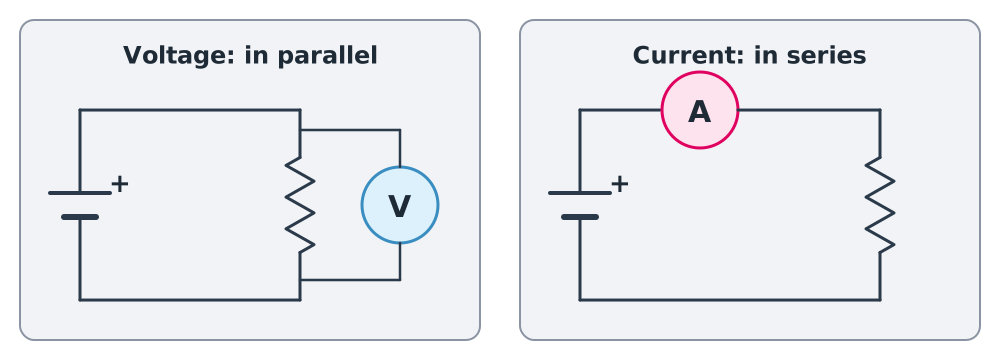
A digital multimeter measures several quantities. How you connect it depends on what you measure.
| Measurement | Connection | Caution |
|---|---|---|
| Voltage (V) | Parallel, across two points | Choose DC or AC correctly |
| Current (A) | Series, break the circuit so current flows through the meter | Move the lead to the A or mA jack; never exceed the fuse rating |
| Resistance (Ω) | Across the component | Always power the circuit off first |
| Continuity | Across a wire or joint | Finds broken wires and shorts |
The most common hazard
If the test lead is still in the A jack and you measure across a battery, the meter becomes a near-zero-resistance short. Huge current flows, the meter’s fuse blows, and in severe cases there is an arc flash. After measuring current, move the lead back to the V jack immediately.
Reading meter accuracy
Makers state accuracy as , where a digit is the last displayed place.
Example 1
A meter specified ±(0.5% + 2 digits) reads 12.00 V on a range showing two decimal places.
- Percentage part V
- Digit part V
- The true value lies within V, that is 11.92–12.08 V
When judging whether two cells differ by 0.05 V, this uncertainty matters a great deal.
Measurement categories (CAT)
IEC 61010-1 classifies measurement environments by the likelihood of transient overvoltages; the closer to the mains supply, the more dangerous.
| Category | Example measurement points |
|---|---|
| CAT I / CAT 0 | Electronics not connected to mains, such as drone batteries and circuits |
| CAT II | Equipment plugged into mains, such as chargers |
| CAT III | Building installations, distribution boards, feeders |
| CAT IV | The utility connection, electricity meters, outdoor lines |
Always use a meter and leads rated for the category and voltage of the point you measure, or higher. Most drone work is low-voltage, but measuring a charger or supply plugged into mains needs at least CAT II.
The oscilloscope
A multimeter shows an average or RMS value but cannot show the waveform. An oscilloscope plots voltage against time, so it is used for PWM signals, noise and voltage spikes.
The screen is divided into divisions: the horizontal axis is set by time/div, the vertical by volts/div.
Example 2. Measuring an ESC signal
With time/div = 0.5 ms, a pulse spans 3 divisions and one period spans 5.
- Pulse width ms = 1500 µs, 50% throttle
- Period ms, frequency Hz
Beware the scope ground
The ground clip of a bench oscilloscope probe is usually connected to mains earth. Clipping it to a point that is not circuit ground creates a short through earth. Clip probe ground to circuit ground only.
Electrical safety
The two main electrical hazards are electric shock, when current passes through the body, and fire or arcing, when a short circuit carries high current.
- 230 V mains can kill. Currents in the tens of milliamps through the heart are dangerous, which is why residual-current devices (RCDs) for personal protection trip at 30 mA.
- Drone batteries are low-voltage, so shock is unlikely, but they can deliver hundreds of amps into a short, making wires, rings or watch straps glow and burn within seconds.
Lab rules:
- Remove rings, watches and metal jewellery before working on batteries.
- Connect the battery last and disconnect it first.
- Use insulated tools and cover unused wire ends.
- Apply first power through a smoke stopper or a current-limited supply.
- Remove propellers for all bench tests.
Charging and handling lithium batteries
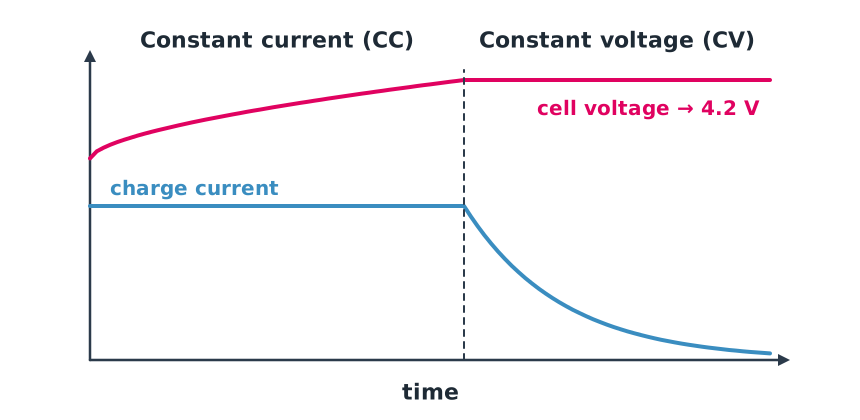
Lithium-polymer cells charge by CC/CV: first at constant current until the cell reaches 4.2 V, then at constant voltage while the current tapers off until full.
| State | Approximate voltage per cell |
|---|---|
| Fully charged | 4.20 V |
| Nominal | 3.7 V |
| Long-term storage | about 3.8 V |
| Do not go below (under load) | about 3.3–3.5 V, per the maker |
A fully charged 6S pack is therefore V.
Battery safety practice
- Charge with a balance charger set to the correct chemistry and cell count, at no more than the maker’s rated current (often 1C).
- Charge on a non-flammable surface, in a fire-safe container, and supervised.
- Stop using any battery that is swollen, deformed, smells or is unusually hot. Isolate it in a fire-safe container and dispose of it through your organisation’s procedure.
- In a fire, cut power to the charger, move away from toxic smoke and follow the lab’s emergency plan with the correct extinguisher.
- Air transport must follow airline rules and the Wh limits covered in DRT 111.
Module lab
In class (practical assessment)
- Measure each cell’s voltage through a battery’s balance lead, record it and state the battery’s condition.
- Measure current in an LED circuit and a small motor circuit, then correctly move the lead back to the V jack.
- Measure the pulse width and frequency of a servo tester’s signal with an oscilloscope.
- Check continuity in a sample wiring harness and find the fault your instructor has set.
- Demonstrate safe battery charging using the checklist.
Common mistakes
Watch out
- Measuring voltage with the lead in the A jack, causing a short.
- Measuring resistance in a powered circuit, giving wrong readings and risking the meter.
- Using a meter rated below the CAT of the point measured.
- Clipping the scope ground to the wrong point.
- Leaving batteries charging unattended.
Summary
- Measure voltage in parallel, current in series, resistance with power off, and move the lead back to V after measuring current.
- Meter accuracy is ; account for it when comparing close values.
- Choose instruments by CAT rating under IEC 61010-1.
- On an oscilloscope, time and voltage are divisions times the per-division setting.
- Lithium cells charge CC/CV to 4.2 V, are stored at about 3.8 V, and must always be handled by safety practice.
Check your understanding
- How must a multimeter be connected to measure motor current?
- A meter specified ±(1% + 3 digits) reads 5.00 V (two decimals). What range contains the true value?
- With time/div = 2 ms, one period spans 10 divisions. What is the frequency?
- What is the voltage of a fully charged 4S pack?
- What minimum CAT rating is needed to measure a mains wall socket?
Answers
- In series, with the lead in an A jack of adequate rating
- V, so 4.92–5.08 V
- Period ms, frequency 50 Hz
- V
- CAT II, rated at least 300 V
Key formulas
| Multimeter uncertainty | |
| Period and frequency on a scope | |
| Full lithium pack voltage |
Key references
- International Electrotechnical Commission. (2010). Safety requirements for electrical equipment for measurement, control, and laboratory use: Part 1. General requirements (IEC 61010-1:2010).
- Fluke Corporation. ABCs of multimeter safety [Application note]. link
- Horowitz, P., & Hill, W. (2015). The art of electronics (3rd ed.). Cambridge University Press.
- Federal Aviation Administration. (2023). Aviation maintenance technician handbook – General (FAA-H-8083-30B). link
Further reading
Study the assigned knowledge units in advance, review media and take the module quiz
Electrical measurement and electrical safety
Lithium battery safety
KiCad
In class / field
Lab or field practice from worksheets with a safety checklist
Learning evidence: Checked worksheets and quiz results